Key Takeaways
Takeaway 1: Fairfax County’s mature hardwood canopy and dense residential development create a high-intensity spotted lanternfly environment where infestations spread rapidly between properties and worsen significantly without intervention.
Takeaway 2: Trees weakened by spotted lanternfly feeding are significantly more vulnerable to secondary infections from fungal disease and bark beetles — damage that can accelerate decline far beyond what the lanternfly feeding alone would cause.
Takeaway 3: Homeowners in Fairfax who have already seen spotted lanternfly activity in previous seasons should schedule treatment before the nymph hatch in spring — reactive treatment after peak adult populations are visible is always behind the curve.
Fairfax County homeowners have been dealing with spotted lanternfly pressure long enough now to recognize the seasonal pattern: the insects appear in late summer, the trees look rough, the outdoor spaces get coated in honeydew, and then the cold weather arrives and the adults die and it feels like the problem ended. It didn’t. By late October, the egg masses that will hatch into next spring’s population are already in place on the trees, fences, and structures around your property, and the cycle begins again the following April.
The Fairfax spotted lanternfly problem has not resolved itself in the years since the pest arrived, and it won’t. The conditions in Fairfax — the mature hardwood canopy, the mixed-use landscape that connects residential neighborhoods to forested corridors, and the dense property development that allows populations to spread freely between yards — create a spotted lanternfly environment that sustains high population levels without active management. Finding a reliable spotted lanternfly exterminator Fairfax homeowners can work with on an annual basis is the most effective response available to property owners who want to protect what they have.
Why Fairfax Is Particularly Challenging for Spotted Lanternfly Management
Fairfax County’s combination of established residential neighborhoods and mature tree canopy is both one of its most valued characteristics and one of the factors that makes spotted lanternfly management particularly challenging. Dense tree populations provide extensive habitat and feeding resources for spotted lanternflies, and the close proximity of properties in established Fairfax neighborhoods means that a treated property is always adjacent to potential reinfestation sources.
The county’s forested stream corridors, parkland, and utility easements provide connected habitat that allows lanternfly populations to move freely between wooded natural areas and residential yards. Properties backing up to these forested corridors face the highest and most persistent infestation pressure because they are directly connected to large untreated population reservoirs that produce adults throughout the summer and fall feeding season.
The Secondary Damage Problem: What Happens After Spotted Lanternfly Feeding
The most direct damage spotted lanternflies cause is the sap loss from feeding, which progressively weakens the host tree. But the damage doesn’t stop there. Trees weakened by lanternfly feeding are significantly more vulnerable to a range of secondary problems that can accelerate decline far beyond what the initial feeding damage alone would cause.
Sooty mold developing on honeydew reduces photosynthesis by blocking sunlight from leaf surfaces. Trees operating with reduced photosynthetic capacity allocate less energy to root development and disease resistance. Bark beetles and wood-boring insects — which are attracted to stressed trees and typically can’t establish in healthy ones — find weakened lanternfly-damaged trees much more suitable hosts. Fungal infections including cankers and root rots develop more readily in trees whose immune response is compromised by repeated sap extraction. The combination of direct and secondary damage is what causes trees to decline visibly after two or three seasons of significant lanternfly pressure, even when the feeding damage in any single year might appear manageable.
Identifying the Highest-Risk Trees on Your Fairfax Property
Not all trees on a Fairfax property face equal spotted lanternfly risk. Tree of heaven is the highest-risk host and the primary population driver wherever it’s established. Among hardwoods, black walnut, maple, and willow face the heaviest lanternfly pressure. Oak and black cherry are also frequently targeted. Fruit trees — apple, peach, plum — are at significant risk and suffer both feeding damage and quality loss from the honeydew and mold that accumulates during the fall feeding season.
Trees with any of these as species, particularly those that are already showing signs of stress from drought, compaction, or previous pest damage, should be considered high priority for treatment. A professional property assessment identifies which trees are most at risk on your specific property and helps allocate treatment resources to the areas where they’ll produce the most protection.
The Pre-Treatment Inspection: Why It Matters
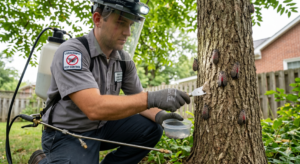
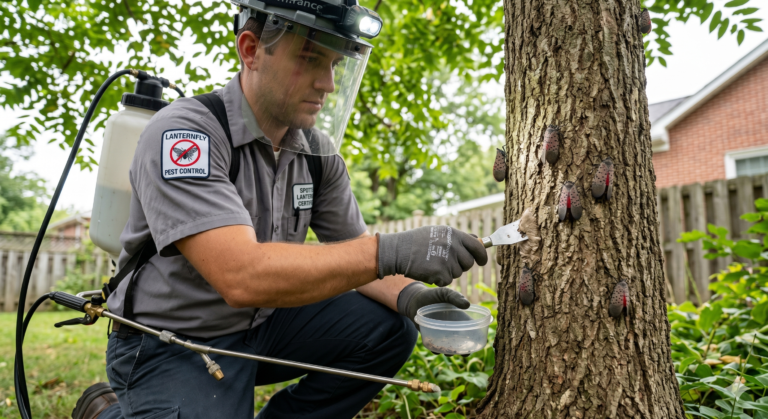
One of the things that distinguishes professional spotted lanternfly treatment from DIY approaches is the pre-treatment inspection. A trained exterminator approaching a Fairfax property looks for things that most homeowners wouldn’t think to check: egg masses on the undersides of deck boards, on the smooth bark of smaller-diameter tree branches, on concrete and stone surfaces in shaded areas, and on fence posts and rails throughout the property.
This inspection produces a map of where the infestation is established and where the reproductive population is most concentrated. Treatment applied based on this map is substantially more effective than treatment applied only where insects are visible on the day of service, because it addresses the egg-mass population that would otherwise produce the following season’s infestation regardless of how thoroughly the adults are treated.
What Bull Run Turf Care & Pest Control Offers Fairfax Homeowners
Bull Run Turf Care & Pest Control provides spotted lanternfly exterminator services to Fairfax homeowners built around the specific conditions of this county’s residential landscape. The assessment-first approach, the life-stage-appropriate treatment calendar, and the egg mass management that protects future seasons are all standard elements of the service — not add-ons that require an upgrade.
Fairfax homeowners who have been living with spotted lanternfly pressure for multiple seasons know that the problem doesn’t go away on its own. With the right professional management relationship, it can be controlled to levels where it stops dictating how you use your outdoor space and damaging the trees you’ve invested in for years.
Frequently Asked Questions
Are there spotted lanternfly traps that work without chemicals?
Circle traps — mechanical traps that wrap around tree trunks and funnel upward-climbing insects into collection containers — are effective chemical-free options for reducing populations on specific host trees. They work best as supplements to chemical treatment rather than standalone control measures, and they must be checked and emptied regularly to remain effective. Sticky band traps are less recommended because they capture non-target wildlife including birds and beneficial insects.
How do spotted lanternflies affect fruit trees in Fairfax?
Fruit trees are among the most heavily affected by spotted lanternfly feeding in Fairfax. The direct feeding damage weakens the trees and reduces fruit production. The honeydew coating that accumulates on developing fruit promotes mold growth that damages the fruit’s surface. Trees that receive repeated heavy feeding over multiple seasons may show reduced productivity and structural decline that affects their long-term viability as productive fruit trees.
Should I remove tree of heaven from my Fairfax property to reduce spotted lanternfly pressure?
Tree of heaven removal is generally a beneficial long-term management step that reduces the primary host plant available to local lanternfly populations. However, removal must be done carefully — improperly cut tree of heaven stumps resprout aggressively, potentially producing multiple stems for each one removed. Female trees can produce large quantities of viable seed that remain in the soil for years. Removal is most effective when the stump is treated with an appropriate herbicide immediately after cutting. Consult with a professional before removing established tree of heaven specimens.
Bull Run Turf Care & Pest Control
4229 Lafayette Center Dr STE 1825, Chantilly, VA 20151, United States
Phone: (571) 430-5697
Website: bullrunturf.com
Instagram: @bullruntrf
Facebook: web.facebook.com/bullrunturf