Key Takeaways
Takeaway 1: Sterling’s position along the Route 7 corridor — one of the highest-traffic commercial routes in Loudoun County — has accelerated spotted lanternfly spread into residential neighborhoods through vehicle and equipment transport of egg masses.
Takeaway 2: Sterling homeowners who have seen spotted lanternfly activity in two or more consecutive seasons are past the point where the problem self-resolves — annual professional treatment is now the baseline needed to prevent progressive tree decline.
Takeaway 3: The most impactful action a Sterling homeowner can take right now, regardless of the current season, is to schedule a professional property assessment — the assessment identifies what’s already established and shapes the treatment timing that follows.
Sterling’s residential neighborhoods have seen spotted lanternfly populations grow steadily in recent seasons, and the trajectory is consistent with what has happened in other Northern Virginia communities that are several years further into the infestation cycle: each season brings a larger starting population than the last, the feeding pressure on residential trees increases, and homeowners who have been managing with consumer products or ignoring the problem find themselves watching trees they’ve had for years begin to show real signs of decline.
The Route 7 corridor that runs through Sterling has accelerated the spread of spotted lanternflies through the area by providing constant movement of vehicles and commercial goods — and with them, egg masses — into residential neighborhoods from infested areas in Fairfax County and points east. The pest didn’t wait for Sterling, and homeowners in this community are now dealing with an established infestation that requires the same professional management response that communities in Fairfax County have been implementing for several seasons. A reliable spotted lanternfly exterminator Sterling residents can work with annually is the most effective tool available.
What’s Already Established in Sterling
The honest assessment for Sterling homeowners is that the spotted lanternfly infestation in this community is already established — not arriving, not potential, but present and active. Properties that have seen adults in multiple consecutive seasons are not dealing with a problem that might become significant. They are dealing with one that is already significant and growing. The egg masses laid over multiple seasons have built a local population that is now large enough to sustain itself through normal seasonal variation.
This means the appropriate response has shifted from prevention to management. Prevention — reducing the likelihood of initial establishment — is no longer the relevant frame for Sterling. The relevant frame is management: maintaining the population at levels that don’t cause significant damage, protecting the highest-value plants on the property, and preventing the year-over-year population growth that leads to the kind of widespread tree decline visible in communities where infestations have been left unmanaged for many seasons.
Immediate Steps Sterling Homeowners Can Take
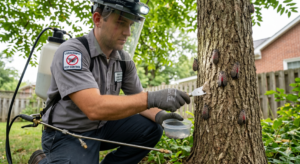
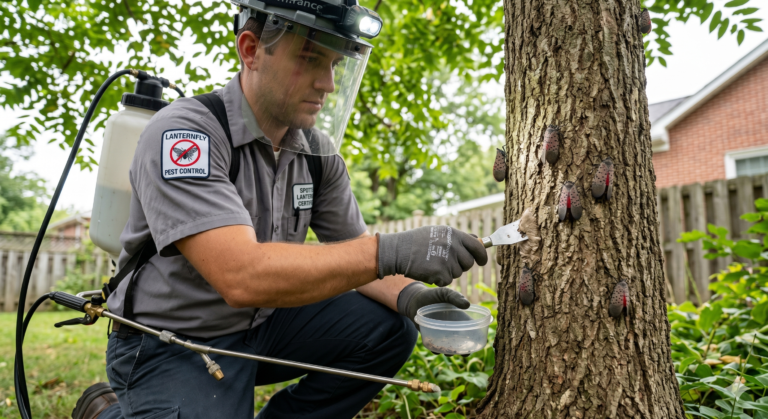
Regardless of where you are in the calendar year, there are productive actions a Sterling homeowner can take immediately toward spotted lanternfly management. A property assessment by a professional exterminator is always the right first step — it establishes the baseline condition of the infestation, identifies which plants are most at risk, locates egg masses currently present on the property, and produces the information needed to schedule treatment at the most impactful point in the upcoming season.
If it is currently fall or winter, egg mass inspection and removal is the highest-priority action. Finding and destroying egg masses now directly reduces the population that will hatch in spring and provides the biggest return on management investment of any action available during the dormant season. If it is currently spring, the priority is scheduling a nymph-stage treatment before the first instar population disperses. If it is summer or fall and adults are active, a professional residual spray treatment to reduce the active adult population and limit egg mass production is the immediate priority.
The Compounding Argument: Why Waiting Costs More
The most common reason Sterling homeowners give for delaying professional spotted lanternfly treatment is cost — the treatment expense feels optional when the trees still look mostly fine. This calculus changes when the full cost picture is considered. The trees on a Sterling residential property represent years of growth and thousands of dollars in replacement cost. A mature shade tree that has been in a yard for 20 years and contributes meaningfully to property value, summer cooling costs, and landscape aesthetics is an asset worth protecting.
Professional spotted lanternfly treatment for a residential property in Sterling costs a fraction of what removing and replacing a single mature tree costs. It costs far less than the structural damage to outdoor living spaces that years of untreated honeydew and sooty mold accumulation produces. And it costs dramatically less than the combined remediation — pest treatment plus tree care plus surface restoration — required to address an advanced infestation that has been allowed to cause significant damage.
What Makes Sterling Properties High-Risk
Several characteristics common to Sterling residential properties create elevated spotted lanternfly risk. The community’s established residential neighborhoods feature mature shade trees — primarily maples and oaks — that are among the lanternfly’s preferred feeding hosts. Properties along wooded borders and stream corridors in the southeastern part of the community face higher sustained pressure from natural area population sources. Commercial development along Route 7 and the surrounding area brings vehicles, materials, and foot traffic that consistently introduces new egg masses into the community.
Sterling’s proximity to Loudoun County’s northern border with Fairfax County also means that the established and high-pressure infestation in Fairfax County communities represents an ongoing source of adult immigration into Sterling yards throughout the feeding season. This cross-county pressure is part of why Sterling homeowners should not expect conditions to improve simply because their immediate neighborhood hasn’t yet reached the same infestation density as communities in eastern Fairfax County.
Bull Run Turf Care & Pest Control: Ready to Help Sterling Homeowners
Bull Run Turf Care & Pest Control provides spotted lanternfly exterminator services to Sterling homeowners with treatment programs designed for the specific conditions of this Loudoun County community. The seasonal treatment calendar — spring nymph treatment, summer and fall adult treatment, fall egg mass management — addresses the infestation at each of its most vulnerable points and produces cumulative improvement in the property’s infestation level over multiple seasons of consistent management.
Sterling homeowners who are ready to stop watching the problem get worse and start managing it effectively have a straightforward path forward. It starts with a phone call and a property assessment, and it produces results that the hardware store solutions have consistently failed to deliver.
Frequently Asked Questions
What is the best thing I can do for my Sterling property right now to address spotted lanternflies?
The best immediate action regardless of season is to schedule a professional property assessment. The assessment establishes what’s currently present on the property, identifies the treatment priorities for the upcoming season, and produces a schedule that addresses the infestation at its most vulnerable points. For homeowners who have already seen activity in multiple seasons, an annual professional management program is the follow-up commitment that actually changes the property’s trajectory.
Can spotted lanternfly damage be reversed once trees have declined?
Mild to moderate spotted lanternfly damage on otherwise healthy trees can often be partially reversed through improved management — reducing the feeding pressure through professional treatment, supporting tree health through proper fertilization and watering, and allowing the tree time to rebuild carbohydrate reserves in seasons without heavy infestation. Severe or chronic damage that has compromised the tree’s vascular system or structural integrity is much harder to reverse and may not be repairable if the tree has declined past a certain threshold. Early treatment is always more effective than trying to reverse advanced decline.
How do I know if the spotted lanternfly activity I’m seeing in Sterling is getting worse?
Compare your observations across seasons. Are you seeing adults earlier in the year than in previous seasons? Are more trees or plant species affected than before? Is the area of your property showing activity larger than it was last year? Is the sooty mold and honeydew accumulation more extensive? Any of these trends indicates a growing infestation that has not been effectively controlled by current management efforts. A professional assessment can confirm the trajectory and recommend adjustments to the treatment plan.
Bull Run Turf Care & Pest Control
4229 Lafayette Center Dr STE 1825, Chantilly, VA 20151, United States
Phone: (571) 430-5697
Website: bullrunturf.com
Instagram: @bullruntrf
Facebook: web.facebook.com/bullrunturf