Key Takeaways
Takeaway 1: Most DIY spotted lanternfly control efforts fail not because the products don’t work at all, but because they’re applied at the wrong life stage, without residual protection, and without addressing egg masses — leaving the infestation cycle fully intact.
Takeaway 2: Systemic trunk injections offer the most sustained protection for high-value trees, delivering an active ingredient that makes the tree itself toxic to feeding lanternflies for the entire growing season.
Takeaway 3: The most cost-effective spotted lanternfly control strategy combines spring nymph treatment, summer/fall adult treatment, and egg mass removal in fall — missing any of these phases significantly reduces the effectiveness of the others.
By now, most homeowners in Northern Virginia have tried something for spotted lanternflies. A spray from the hardware store. A DIY trap built from mesh and sticky bands. Knocking them off the fence with a broom. Some of these approaches produce visible results — you kill some insects, see fewer of them for a day or two — but none of them actually control the infestation, and most homeowners eventually reach the conclusion that nothing works. This is not accurate. The right professional approach to spotted lanternfly control near me genuinely works. The question is what “the right approach” actually means and how it differs from what most DIY efforts involve.
This article walks through the spotted lanternfly control methods that produce real, measurable results — what they are, why they work, and what the full-season control picture looks like when each element is applied correctly and in sequence.
What DIY Control Gets Right and Where It Breaks Down
DIY spotted lanternfly control isn’t entirely without value. Physical removal — knocking insects into soapy water, destroying accessible egg masses — genuinely reduces local population numbers when done consistently. Sticky band traps on tree trunks capture adults and nymphs moving up and down preferred host trees and can meaningfully reduce the feeding population on specific trees.
Where DIY control consistently breaks down is at scale and completeness. Sticky bands trap a portion of the insects moving on treated trees but leave those on other surfaces, on neighboring trees, and migrating in from adjacent properties entirely unaffected. Consumer spray products kill insects on contact but provide no residual protection, meaning the population resets within days as new individuals move in. And egg masses — the reproductive foundation of the following year’s population — require systematic, comprehensive inspection to find and remove, an inspection that is very difficult to conduct thoroughly without professional training in where to look and what to look for.
Circle Traps: A Mechanical Control Tool That Works
One of the most effective mechanical spotted lanternfly control tools available is the circle trap — a funnel-shaped trap that wraps around a tree trunk and redirects insects climbing upward into a collection container. Unlike sticky bands, circle traps don’t injure non-target wildlife including birds and beneficial insects that sticky traps frequently capture inadvertently.
Circle traps work because spotted lanternflies are strongly phototactic — they move upward toward light and aggregate near the top of host trees. By intercepting this upward movement and funneling insects into a collection container, circle traps can capture substantial numbers of lanternflies over the course of a season on preferred host trees. They’re most effective as a supplement to chemical treatment on trees where insecticide application is not appropriate — near water features, in organic gardens, or on food-producing trees where pesticide use is restricted.
Systemic Trunk Injections: The Best Protection for High-Value Trees
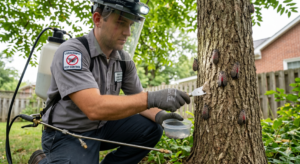
For high-value trees on Northern Virginia properties — mature oaks, maples, walnuts, and ornamentals that would be expensive or impossible to replace — systemic trunk injection is the most effective and most sustained treatment available. Unlike surface sprays that affect only insects in contact with treated surfaces, systemic products are injected directly into the tree’s vascular system and move throughout the plant with its normal sap flow.
Spotted lanternflies feeding on a systemically treated tree ingest the active ingredient through their normal feeding behavior and are killed without requiring direct contact with a sprayed surface. A single trunk injection treatment applied in spring can provide protection throughout the entire growing season — through the nymph phase, the adult feeding phase, and into fall — without requiring repeated applications. This makes systemic treatment the highest-leverage investment for spotted lanternfly control on trees of significant value.
Residual Spray Treatments: The Foundation of Property-Level Control
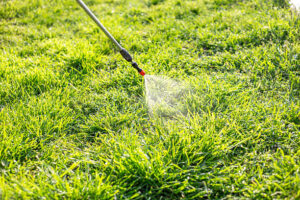
For property-level spotted lanternfly management — reducing the overall population across the landscape rather than protecting specific trees — residual spray treatments applied by a professional exterminator are the standard approach. Professional-grade residual insecticides remain active on treated surfaces for two to four weeks, killing lanternflies that contact treated areas after the initial application. This extended window of protection addresses reinfestation from neighboring properties more effectively than the zero residual activity of consumer contact sprays.
Application targets include the lower trunks and main branches of preferred host trees, perimeter fence lines and structures where lanternflies aggregate, and any surfaces where high concentrations of activity have been observed. Coverage depth and thoroughness matter significantly — spotted lanternflies spend time on surfaces that are often difficult to reach with consumer handheld sprayers, and professional equipment achieves better penetration in these areas.
Egg Mass Management: The Fall Priority That Determines Next Spring
No spotted lanternfly control program is complete without fall egg mass management. Every egg mass that survives winter on your property is 30 to 50 insects that will be active next spring, and a property with a significant adult population in fall can accumulate dozens of egg masses across trees, structures, and surfaces before the first frost.
Professional egg mass inspection covers all the surfaces that a homeowner is unlikely to check systematically — the upper portions of tree trunks, underneath deck and porch structures, on the underside of outdoor furniture, on the wheel wells and undercarriages of vehicles regularly parked on the property. What’s found is documented and destroyed on site. This fall service visit pays dividends through the entire following season by reducing the starting population that spring treatment has to work against.
Building a Season-Long Spotted Lanternfly Control Calendar
The full-season control picture that professional spotted lanternfly exterminator near me services provide combines all of these elements in a coordinated calendar. Spring nymph treatment in late April to mid-May disrupts the season before populations build. Systemic trunk injections in spring protect high-value trees through the growing season. Residual spray applications in late summer target peak adult populations at their most damaging period. Fall egg mass inspection and removal protects the following spring from the current season’s reproductive output.
Homeowners who receive all of these elements on a consistent annual schedule see the cumulative benefit — populations that are measurably lower each season as the egg mass reservoir on their property is progressively reduced and the adult population that reaches their trees is consistently intercepted before it can cause significant damage.
Frequently Asked Questions
Does spotted lanternfly treatment harm pollinators?
Professional applicators schedule treatments to minimize pollinator impact by avoiding application during bloom periods on flowering plants and using targeted application methods that focus on host tree trunks and aggregation sites rather than broadcast application across flowering vegetation. Informing your technician about active flowering areas on your property allows them to adjust the application plan accordingly.
How do I know which control method is right for my property?
The right combination of control methods depends on the severity of your infestation, the species and value of trees on the property, the surrounding environment, and the time of year. A property assessment by a professional spotted lanternfly exterminator will evaluate these factors and recommend a treatment plan appropriate to your specific situation. There is no single correct approach that works equally well for every property.
Can spotted lanternflies be fully eliminated from my property?
Spotted lanternflies can be managed to very low population levels on a treated property, but full elimination is not realistic for most Northern Virginia homeowners because the surrounding landscape contains established populations that produce adults capable of migrating onto your property regardless of how thoroughly it’s been treated. The goal of professional management is not elimination of the species but reduction of the population on your property to levels that don’t cause significant plant damage.
Bull Run Turf Care & Pest Control
4229 Lafayette Center Dr STE 1825, Chantilly, VA 20151, United States
Phone: (571) 430-5697
Website: bullrunturf.com
Instagram: @bullruntrf
Facebook: web.facebook.com/bullrunturf