Key Takeaways
Takeaway 1: Chantilly’s mature residential tree canopy and proximity to forested corridors make it one of the higher-risk communities in Fairfax County for sustained spotted lanternfly infestation.
Takeaway 2: By the time most Chantilly homeowners notice spotted lanternfly activity, the feeding season is already well underway and egg masses for next year may already be in place.
Takeaway 3: Annual professional treatment is the only reliable way to manage spotted lanternfly populations on a Chantilly property — reactive treatment after damage appears is always playing catch-up.
There’s a version of this problem that Chantilly homeowners are very familiar with. You notice some unusual insects on your trees toward the end of summer. You look them up, confirm they’re spotted lanternflies, maybe scrape a few egg masses off the fence — and then you move on, assuming the problem is manageable. The following spring, the nymphs hatch in larger numbers than the year before. By fall, the infestation is visibly worse than anything you saw last season. And the trees that looked fine two years ago are starting to show the kind of decline that doesn’t bounce back quickly.
This is the compounding reality of untreated or undertreated spotted lanternfly pressure, and it’s playing out across Chantilly’s established neighborhoods right now. The good news is that professional treatment genuinely works when it’s applied correctly and consistently. The challenge is getting homeowners to act before the damage accumulates rather than after it does. Finding a reliable spotted lanternfly exterminator Chantilly residents trust is not a decision that gets easier by waiting.
What Makes Chantilly Particularly Vulnerable
Chantilly sits at the intersection of established residential development and the kind of forested and semi-rural land that supports large spotted lanternfly populations. The community’s mature hardwood trees — oaks, maples, walnuts, and others — are prime feeding targets. The wooded buffers, stream corridors, and utility easements that thread through and around Chantilly neighborhoods provide the kind of connected habitat that allows lanternfly populations to move freely between properties and from natural areas into yards.
The density of tree canopy that makes Chantilly neighborhoods feel established and appealing is the same characteristic that makes them attractive to spotted lanternflies. Properties with multiple mature trees, especially those bordering wooded areas or properties with tree of heaven present, face the highest and most persistent infestation pressure. But even yards with fewer trees are not immune — lanternflies feed on ornamental shrubs, garden plants, and a wide range of non-tree vegetation as well.
The Compounding Damage Problem: Why Each Season Gets Worse
One of the things that makes spotted lanternfly infestations particularly frustrating is how they compound over time without treatment. A first-year infestation may produce feeding damage that the trees mostly absorb without catastrophic visible decline. But the egg masses laid that fall produce a spring population that begins feeding before the trees have fully recovered. Each season of feeding without intervention leaves the trees in a slightly weakened state entering the next year.
This is especially true for trees that are also managing other stressors — drought stress from the previous summer, soil compaction from foot traffic or construction, or competition from turf grass for root-zone water and nutrients. Spotted lanternfly pressure on top of existing stress accelerates decline in ways that can be difficult to reverse once the tree has reached a certain threshold. Chantilly homeowners who have watched a previously healthy tree decline over two or three seasons without an obvious cause should consider whether repeated lanternfly infestation is contributing to what they’re seeing.
Identifying Active Spotted Lanternfly Presence on Your Property
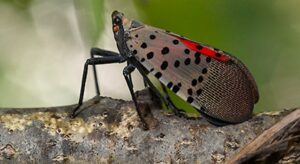
Active spotted lanternfly infestation in Chantilly can be identified through several signs that don’t require seeing the insects themselves. Honeydew accumulation on outdoor surfaces — decks, furniture, vehicles parked near trees — is one of the most reliable early indicators. The sticky coating that appears during the late summer feeding season is produced in quantity by large feeding populations and is often noticed before the insects themselves become conspicuous.
Sooty mold following the honeydew is another indicator. Black mold growth on leaf surfaces and bark that appears during the summer and fall — not the result of moisture or disease — is a sign of significant feeding activity above. Egg masses on smooth bark surfaces, fence posts, stone walls, and outdoor furniture can be found from October through April, and their presence confirms that an established population used your property as a breeding site. A property inspection by a professional spotted lanternfly exterminator will identify all of these signs systematically rather than leaving it to the homeowner to locate them.
Why Chantilly’s Neighborhood Density Creates a Shared Problem
Spotted lanternfly management in a dense residential community like Chantilly is not just an individual property issue — it’s a neighborhood-level challenge. Properties where treatment is consistently applied provide much better outcomes than isolated treated properties surrounded by untreated ones, because the treated properties face constant reinfestation pressure from the active populations next door.
This dynamic is worth understanding not as a reason to give up on treating your own property, but as context for why professional treatment on a consistent annual basis — rather than a one-time reactive response — is so much more effective. A property that is treated every season maintains a substantially lower population than one that is treated only in years when the problem becomes impossible to ignore. Over time, the treated property also supports better tree health, which makes the trees themselves more resilient to the feeding pressure that continues from surrounding areas.
What a Professional Treatment Plan Looks Like for a Chantilly Property
Bull Run Turf Care & Pest Control develops spotted lanternfly treatment plans for Chantilly properties based on a property-specific assessment rather than a standard package. The assessment identifies which trees and plants are most at risk, where egg masses are present, and what the likely reinfestation pressure looks like based on the surrounding environment. From there, the treatment plan is built around the seasonal windows that produce the best results: early spring nymph treatment, peak adult treatment in late summer, and fall egg mass inspection and removal.
Properties that receive a full seasonal treatment plan see consistently lower infestation levels than those that receive a single treatment per year. The difference isn’t just in the products used — it’s in the timing, the coverage, and the follow-up that ensures each treatment is reinforced before the population has a chance to rebuild significantly.
Protecting Your Chantilly Property for the Long Term
Spotted lanternflies are going to be a presence in Chantilly for the foreseeable future. The invasive population is established, the host plant base is extensive, and natural control mechanisms are not sufficient to reduce populations to non-damaging levels on their own. What homeowners can control is the impact those insects have on their specific property — and that impact is significantly reducible with consistent professional management.
Bull Run Turf Care & Pest Control is based in Chantilly and serves this community with the local knowledge and commitment that a persistent regional pest requires. The spotted lanternfly control protocols they use are built for Northern Virginia’s specific conditions — not adapted from a generic national playbook. If you’ve been watching your trees struggle and wondering what to do next, the answer starts with a property assessment and a treatment plan built around what’s actually happening on your land.
Frequently Asked Questions
How do spotted lanternflies affect property values in Chantilly?
Significant spotted lanternfly damage to mature trees can affect property value both directly — through the loss of established landscape features that take decades to replace — and indirectly, through the decline in curb appeal and outdoor livability that comes with damaged trees, sooty mold on surfaces, and swarms of insects coating outdoor spaces. Proactive treatment protects both the trees and the investment they represent.
Can spotted lanternflies damage my vegetable garden?
Yes. While spotted lanternflies prefer woody plants, they will feed on a wide range of vegetation including garden vegetables, particularly when preferred host plants are not available or are already crowded with competing insects. Tomatoes, peppers, and squash can sustain feeding damage during peak infestation periods. Protecting the perimeter of garden areas is part of a thorough treatment plan.
What should I do if I find spotted lanternfly egg masses in winter?
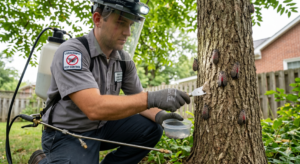
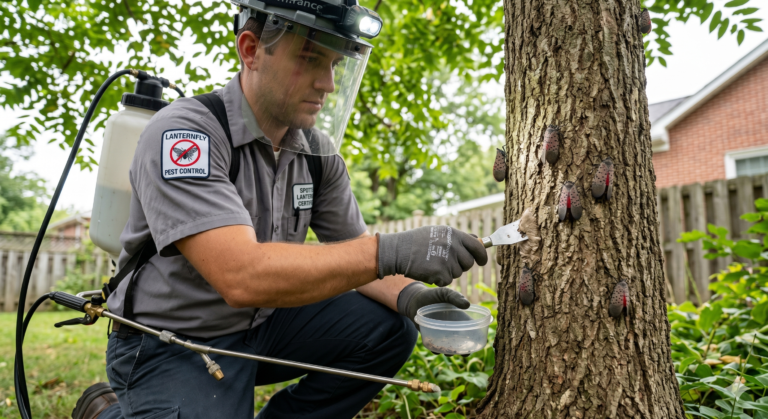
Scrape egg masses into a sealed bag or container with hand sanitizer or rubbing alcohol and dispose of them. Use a hard card, putty knife, or similar tool to scrape them completely from the surface. Document where you found them and how many — this information is useful for your pest control provider when planning spring treatment timing and helps Virginia’s Department of Agriculture track infestation spread.
Bull Run Turf Care & Pest Control
4229 Lafayette Center Dr STE 1825, Chantilly, VA 20151, United States
Phone: (571) 430-5697
Website: bullrunturf.com
Instagram: @bullruntrf
Facebook: web.facebook.com/bullrunturf