Key Takeaways
Takeaway 1: Sterling’s heavy clay soil requires a different lawn care approach than the lighter soils found elsewhere in Northern Virginia — what works in a neighboring community may actively harm your lawn here.
Takeaway 2: Overwatering is one of the most common and damaging lawn care mistakes Sterling homeowners make — clay soil holds moisture longer than other soil types, and watering on a standard schedule without accounting for this creates disease and root problems.
Takeaway 3: Annual core aeration is the single most impactful treatment Sterling lawns can receive, because it directly addresses the soil compaction that limits root development and makes every other lawn care input less effective.
Sterling homeowners care about their lawns. The investment in time, equipment, fertilizer, and seed is real, and so is the frustration when the results don’t match the effort. But a significant portion of lawn care failures in Sterling come not from lack of effort but from approaches that aren’t calibrated to the specific conditions of this community. Sterling’s soil, drainage patterns, and microclimate create a lawn care environment that rewards some practices and punishes others, and the generic advice on fertilizer bags and YouTube tutorials isn’t written for this specific set of conditions.
Understanding what Sterling lawns actually need — and equally important, what they don’t — is the foundation of an approach that produces visible, lasting results. Professional lawn care Sterling homeowners invest in accounts for these local specifics in ways that a self-directed program built on general advice usually doesn’t.
The Clay Soil Problem: Understanding Sterling’s Foundation
The dominant soil type in Sterling is a clay-heavy profile with significant compaction potential. Clay particles are much smaller and more closely packed than the sand and silt particles that make up other soil types, which gives clay soil characteristics that affect virtually every aspect of lawn care. Clay retains moisture much longer than other soils — which sounds beneficial but creates problems when it stays wet long enough to limit the oxygen available to grassroots. Clay also drains slowly, making surface pooling and runoff common after significant rainfall.
When clay compacts — which it does readily under foot traffic, mowing equipment, and the simple weight of rainfall over time — the soil structure becomes so dense that water can barely penetrate the surface and roots struggle to grow downward. Lawns on heavily compacted clay soils tend to look stressed in summer even when watered, because the surface inches that roots are confined to dry out quickly while the water that does penetrate can’t reach the shallow root zone efficiently.
Why Overwatering Is a Major Problem in Sterling
Because Sterling homeowners often see their lawns looking stressed in summer, the instinct is to water more. In most cases, this makes the problem worse rather than better. Clay soil that is watered on a daily or near-daily schedule stays saturated in the upper profile, limiting root oxygen and creating the warm, moist conditions that favor fungal lawn diseases like brown patch and dollar spot — both of which are significant summer problems in Loudoun County.
The correct watering approach for Sterling clay lawns is infrequent but deep — typically one to two times per week during dry periods, applying enough water to penetrate to a depth of several inches rather than frequent light applications that wet only the surface. This approach encourages roots to grow downward toward moisture rather than remaining near the surface where they’re more vulnerable to heat and drought stress. A professional lawn care near me program that includes irrigation guidance as part of its service helps homeowners establish the right watering pattern for their soil type rather than guessing.
Core Aeration: The Most Important Treatment Sterling Lawns Get
If there is one lawn care practice that produces more visible improvement in Sterling than any other, it is core aeration. Core aeration is the mechanical removal of small plugs of soil from the lawn surface, creating channels that allow air, water, and nutrients to penetrate the compacted clay profile and reach the root zone. The plugs are left on the surface to break down and reincorporate into the lawn over a few weeks.
The effects of aeration compound over time. Immediate effects include improved water penetration, reduced surface pooling, and enhanced nutrient availability. Over the following weeks, grassroots begin to grow into the channels created by the aeration, developing deeper and more extensive root systems that improve drought tolerance and overall turf vigor. Overseeding immediately after aeration — a standard practice that takes advantage of the improved soil contact the open channels provide — produces dramatically better germination rates than overseeding without aeration.
Sterling lawns with significant compaction benefit from annual aeration in fall, which is the optimal timing for cool-season turf renovation in Northern Virginia. Properties with very heavy compaction or high foot traffic may benefit from a second aeration in spring.
Common Fertilization Mistakes Sterling Homeowners Make
Fertilization timing and rate are the areas where most Sterling homeowners either underperform or overperform in ways that have real consequences. The most common mistake is applying fertilizer in summer — when cool-season grasses like tall fescue are naturally semi-dormant and stressed by heat — rather than in fall when the grass is actively growing and can use the nutrients efficiently. Summer fertilization of stressed, semi-dormant cool-season turf can burn the lawn and encourage weed growth without producing the green-up the homeowner was aiming for.
The second most common mistake is over-application of quick-release nitrogen products, which produce rapid green-up followed by just as rapid decline and significantly increase the risk of fertilizer burn. Professional lawn care programs use slow-release nitrogen sources that feed the turf gradually over a longer period, producing steady, sustainable growth rather than the flush-and-crash cycle that consumer quick-release products often create.
What a Professional Lawn Care Program for Sterling Looks Like
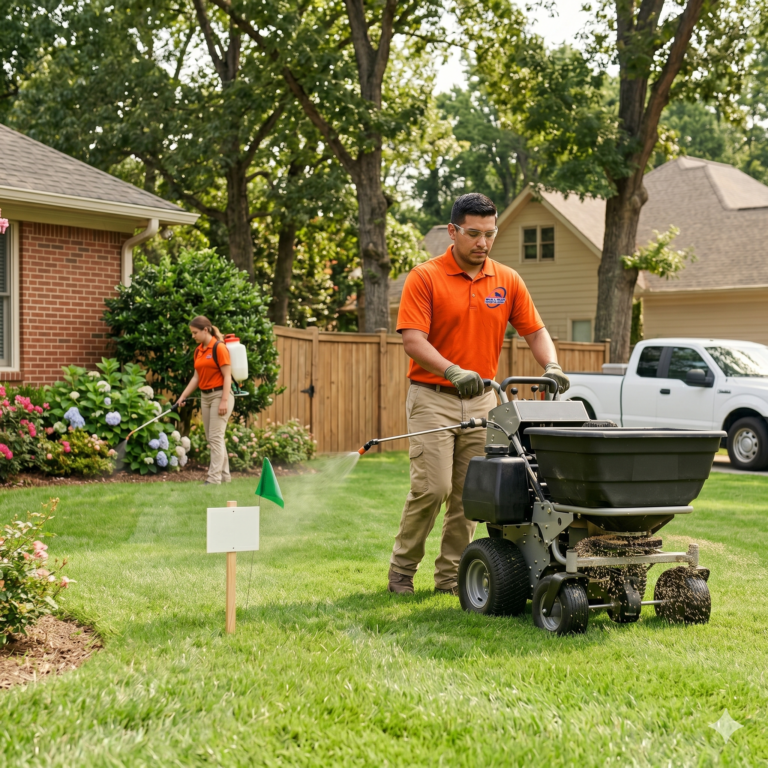
Bull Run Turf Care & Pest Control builds lawn care programs for Sterling properties around the actual conditions of Loudoun County’s soil and climate rather than a generic schedule. The program typically includes pre-emergent weed control in late winter and late summer, fertilization applications timed to the cool-season growth calendar, summer disease management as needed, fall core aeration with overseeding, and periodic assessments of turf health that allow the program to be adjusted as conditions change.
For homeowners who have been putting real effort into their Sterling lawn without seeing the results they want, the professional program offers the calibration to local conditions that changes the trajectory — from a lawn that struggles despite care to one that improves visibly season over season.
Frequently Asked Questions
What grass type grows best in Sterling lawns?
Tall fescue is the dominant cool-season grass in Sterling and throughout Northern Virginia, and for good reason — it’s more heat and drought tolerant than other cool-season options like Kentucky bluegrass and has better adaptability to clay soils. Turf-type tall fescue varieties bred in the past decade have significantly improved texture and disease resistance compared to older varieties. Overseeding with a current, regionally adapted tall fescue variety is recommended whenever renovation work is done.
How do I know if my Sterling lawn needs lime?
Clay soils in Northern Virginia tend to become acidic over time, and acidic soil conditions significantly reduce the effectiveness of fertilizer by limiting nutrient availability to grass roots. A soil pH test — available through Virginia Cooperative Extension or as part of a professional lawn care assessment — will determine whether lime is needed. Most Sterling lawns benefit from lime application at least every two to three years to maintain the near-neutral pH that cool-season grasses prefer.
Is it worth aerating if I have a thin lawn with mostly weeds?
Aeration is still beneficial for compacted clay soils regardless of current turf condition, but it works best as part of a renovation plan that includes overseeding and weed control. Aerating a weed-dominated lawn without overseeding simply helps the weeds grow better. Combine aeration with a fall weed control treatment and overseeding with a quality tall fescue mix for the best results on a thin or weed-dominated Sterling lawn.
Bull Run Turf Care & Pest Control
4229 Lafayette Center Dr STE 1825, Chantilly, VA 20151, United States
Phone: (571) 430-5697
Website: bullrunturf.com
Instagram: @bullruntrf
Facebook: web.facebook.com/bullrunturf