
Key Takeaways
Takeaway 1: White grubs feed on grassroots beneath the soil surface, and by the time brown patches appear in your lawn, the infestation is already well established.
Takeaway 2: Late summer is the most critical treatment window for grub control in Chantilly — missing it means grubs burrow deeper where surface treatments can no longer reach them.
Takeaway 3: Professional grub treatment combines the right product, precise timing, and proper application technique — three factors that store-bought solutions consistently get wrong.
You’ve watered it. You’ve fertilized it. You’ve mowed it on schedule and done everything a responsible Chantilly homeowner is supposed to do. But there are still patches in your lawn that won’t come back — brown, spongy sections that seem to spread a little more each week no matter what you throw at them. From the street, the yard looks mostly fine. Up close, it’s a different story. Those dead zones don’t respond to irrigation. They don’t green up after rain. And when you press your foot down on one of them, the turf gives in a way that healthy grass never should.
Most homeowners in this situation blame the heat, the soil, or their fertilizer brand. They reseed, wait, and watch the new growth fail in the same spots. What they don’t realize is that the problem isn’t above the soil — it’s underneath it. White grubs are feeding on the root system of your lawn right now, and they’ll keep doing it until there’s nothing left to feed on or until someone stops them. This article will show you what grubs are, how to identify them, why treating them on your own usually doesn’t work, and what professional grub control actually looks like from start to finish.
What Are Lawn Grubs and Why Are They So Destructive?
White grubs are the larvae of several beetle species, most commonly Japanese beetles, June bugs, and masked chafers — all of which are well established throughout Northern Virginia. The adult beetles are what you see flying around in midsummer, but the real damage is done by their offspring underground. After eggs are laid in the soil, they hatch into small, C-shaped larvae with white bodies and brown heads. Those larvae immediately begin feeding on the one thing your lawn depends on most: its roots.
Grassroots are the delivery system for everything your turf needs to survive. Water, nutrients, and the structural anchor that holds turf in place all run through the root zone. When grubs sever those roots, the grass above has no way to sustain itself. It dies from the ground up, and it does so quietly — which is why grub damage is so consistently misdiagnosed. Chantilly’s clay-heavy, moisture-retentive soil creates near-perfect conditions for grub development. The soil stays moist long enough after summer rains to support egg incubation, and the organic matter in established lawns gives larvae a dense, nutritious root system to consume. By the time you notice visible damage, a grub population has typically been active beneath your turf for weeks.
How to Tell If Grubs Are Killing Your Lawn
The signs of a grub infestation are recognizable once you know what to look for, but they’re easy to confuse with drought stress or disease if you’re not looking beneath the surface. The first thing you’ll notice is irregular brown patches that don’t respond to watering. Unlike drought damage, which tends to affect the lawn more uniformly, grub damage appears in random shapes and often expands outward as the population spreads.
When you walk across the affected area, you’ll feel the turf give underfoot in a way that feels spongy or hollow — because in a sense, it is. The root system beneath has been compromised, and the grass is no longer anchored the way it should be. In more advanced infestations, you’ll be able to roll back sections of turf like a loose rug, revealing the soil and the grubs themselves just beneath the surface.
Another telling sign is increased wildlife activity in your yard. Skunks, raccoons, and birds — particularly starlings and crows — are highly effective at detecting grubs underground. If you’re seeing more digging activity on your lawn than usual, especially in the same areas where turf is thinning, that’s a strong indicator that something is happening below the surface. Pull back a one-square-foot section of turf in a suspicious area and examine the top two to three inches of soil. Finding more than five grubs per square foot is a clear sign that treatment is needed.
When Grubs Are Most Active in Chantilly, Virginia
Understanding the grub life cycle is essential to treating them effectively, and the timing in Chantilly follows a fairly predictable pattern tied to the region’s climate. Adult beetles begin laying eggs in the soil in late June through July, typically after a period of consistent summer rainfall. Those eggs hatch within two to three weeks, and the newly emerged larvae — still very small and close to the surface — begin feeding immediately.
Late summer, roughly from August through early October, is when grub populations are most damaging and most visible. The larvae are actively feeding near the surface to build up energy before winter, which also makes this the window when grub control near me treatments are most effective at curative intervention. As temperatures drop in fall, grubs move deeper into the soil — below the reach of most surface-applied treatments — where they overwinter. They return to the root zone in spring for a brief second feeding period before pupating into adult beetles and starting the cycle again.
This seasonal pattern is why timing your treatment correctly is so critical. A curative treatment applied in September can eliminate the current generation of larvae before they cause further damage. A preventive treatment applied in May or June stops the eggs from becoming a problem in the first place. Miss either window, and you’re spending money on a product that won’t reach the pest where it lives.
Why DIY Grub Treatments Usually Fail
Walk into any home improvement store in Chantilly and you’ll find grub control products on the shelf. Many homeowners buy them, apply them, and see little to no improvement — not because the products are ineffective in general, but because the way they’re being used doesn’t match how the products actually work.
There are two categories of grub control products: preventive and curative. Preventive products contain active ingredients like chlorantraniliprole and need to be applied in late spring, well before eggs hatch. They work by creating a treated zone in the soil that kills young larvae when they emerge. Applied too late in the season, they have no effect on larvae that are already active and feeding. Curative products, by contrast, use fast-acting active ingredients and are designed to kill existing larvae — but they must be applied during the narrow late-summer window when grubs are still small and near the surface.
Most homeowners apply whichever product they find without distinguishing between these two categories, often applying a preventive product in August when a curative one is needed, or a curative product in June when grubs don’t exist yet. Compounding the problem, both types require thorough irrigation immediately after application to move the active ingredient into the root zone. Without that watering step, the product sits on the surface and breaks down in sunlight before it ever reaches the grubs.
Professional Grub Control in Chantilly: What the Process Looks Like
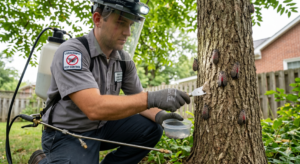
When you bring in a professional for grub control Chantilly homeowners rely on, the process starts with a property assessment rather than an immediate application. A technician examines the affected areas, pulls back turf samples to confirm grub presence, and estimates population density across the lawn. This matters because the right product and timing depend on how far along the infestation is.
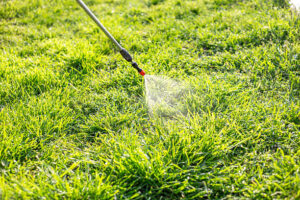
If grubs are still in the early larval stage and it’s within the late-summer treatment window, a curative product is selected and applied at the correct rate for your lawn’s square footage. The technician will advise you on the irrigation schedule required after treatment — typically a half inch of water within 24 hours — because proper watering is what activates the treatment and drives it into the root zone where the grubs are feeding.
For lawns that haven’t yet shown active damage, or where treatment is being done in late spring as a preventive measure, a different class of product is used with a longer residual window. Follow-up visits confirm that grub populations have declined and check for any secondary damage that may need overseeding or soil amendment to fully recover.
How to Prevent Grubs From Returning Season After Season
One treatment addresses the current problem. Preventing grubs from becoming a recurring issue requires a consistent annual approach. The most effective preventive strategy is a late spring application — typically May through early June — using a product with a long soil residual that targets larvae as they hatch from eggs later in the summer. Applied at the right time and watered in properly, preventive treatments interrupt the grub cycle before root feeding begins.
Beyond grub-specific treatment, the overall health of your lawn plays a role in how vulnerable it is. Dense, well-rooted turf can tolerate a low-level grub population without visible damage. Thin, stressed, or compacted lawns have less root redundancy, meaning grubs cause visible harm at lower population thresholds. Pairing grub prevention with annual aeration, a properly timed fertilization program, and weed control keeps your turf in a condition where it can withstand lower-level pest pressure without catastrophic damage.
Why Chantilly Homeowners Trust Bull Run Turf Care & Pest Control
Bull Run Turf Care & Pest Control is a local lawn and pest company serving Chantilly and the surrounding Northern Virginia communities. Because the team works in this region every day, they understand the specific beetle species responsible for grub pressure in Chantilly, the seasonal timing that matters most for effective treatment, and the way local soil conditions influence how products need to be applied.
What separates Bull Run from a typical pest company is the ability to handle both the turf and the pest side of the problem under one roof. Grub damage doesn’t just kill grass — it creates bare patches that need to be reestablished, soil that may need amendment, and a lawn that’s left vulnerable to weeds and secondary pests after treatment. Bull Run manages the full recovery, not just the chemical application, so homeowners aren’t left coordinating between multiple companies to get their lawn back to where it was.
Frequently Asked Questions
How do I know if my lawn has a grub problem?
The most common signs are irregular brown patches that don’t respond to watering, turf that feels spongy underfoot, and sections of grass that pull up from the soil with little resistance. To confirm, pull back a one-square-foot section of turf in a suspect area and examine the top two to three inches of soil. If you find more than five white, C-shaped larvae per square foot, you have an active grub infestation that warrants treatment.
When is the best time to treat for grubs in Chantilly?
Late summer — roughly August through early October — is the prime window for curative grub treatment in Chantilly. This is when larvae are small, actively feeding near the surface, and most vulnerable to treatment. For preventive applications that stop grubs before they cause damage, late spring between May and early June is the correct timing. Applying the wrong product type outside of these windows significantly reduces treatment effectiveness.
Can grubs come back after treatment?
Yes, and this is one of the most important things Chantilly homeowners need to understand about grub management. Adult beetles from neighboring properties, nearby fields, and surrounding landscapes can re-lay eggs in your lawn each summer regardless of how well last year’s treatment worked. A single curative treatment eliminates the current generation of larvae but does not prevent future beetle activity. Annual preventive applications are the most reliable way to stay ahead of the problem and protect your lawn from recurring damage season after season.
Bull Run Turf Care & Pest Control
4229 Lafayette Center Dr STE 1825, Chantilly, VA 20151, United States
Phone: (571) 430-5697
Website: bullrunturf.com
Instagram: @bullruntrf
Facebook: web.facebook.com/bullrunturf