Key Takeaways
Takeaway 1: Carpenter ants don’t eat wood — they excavate it, hollowing out galleries inside walls, beams, and window frames that compromise the structural integrity of your home over time.
Takeaway 2: A visible carpenter ant inside your home almost always indicates a satellite colony already established somewhere in the structure — the nest you can’t see is the real problem.
Takeaway 3: Effective extermination targets the colony, not just the foraging workers, which is why over-the-counter sprays consistently fail to resolve carpenter ant infestations.
Most homeowners who spot a large black ant in their kitchen assume it wandered in from outside. They kill it, forget about it, and move on. Then they see another one. And another. By the time they start taking it seriously, there’s a well-established carpenter ant satellite colony somewhere inside the walls of their home, and the excavation work has been going on for months. Carpenter ants are not a nuisance pest. They are a structural pest, and in Northern Virginia’s heavily wooded residential environment, they are one of the most commonly underestimated threats a homeowner can face.
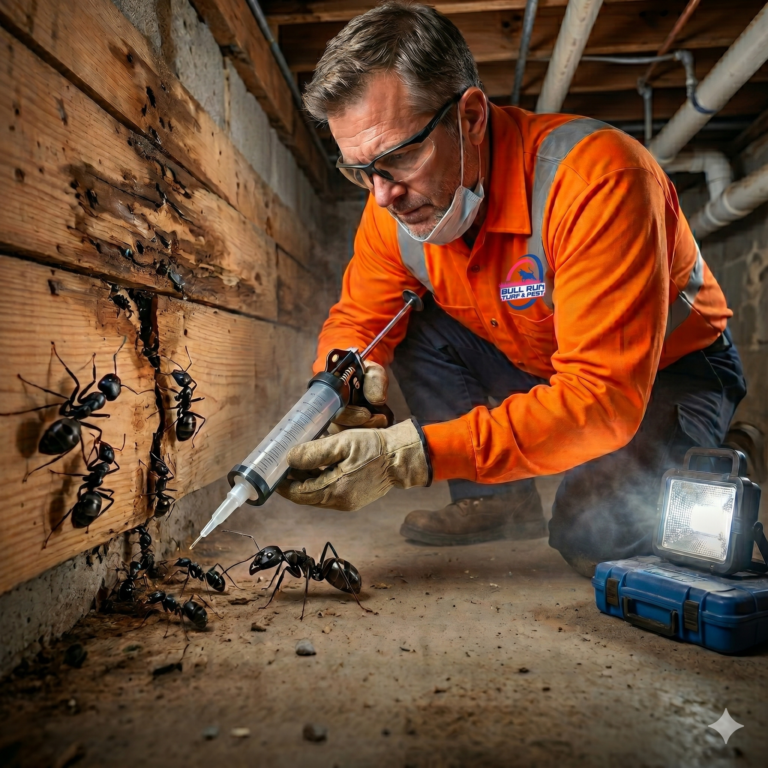
Unlike termites, carpenter ants don’t consume wood. What they do instead is arguably more insidious: they excavate smooth, clean galleries through wood to create nesting space, expelling the debris — called frass — in small piles that look like coarse sawdust. This frass is often the first real evidence homeowners find, usually near window frames, door casings, or baseboards. By the time it’s visible, the colony has typically been active inside the structure for a significant period. If you’ve reached that point, you need a carpenter ant exterminator Northern Virginia homeowners can count on — not another can of spray.
Why Northern Virginia Is High-Risk Carpenter Ant Territory
Carpenter ants thrive in environments with moisture-damaged or decaying wood, and Northern Virginia provides exactly that. The region’s humid summers, frequent rainfall, and abundance of mature hardwood trees create ideal outdoor nesting conditions. Carpenter ants establish their primary nests in decaying wood — dead trees, old stumps, rotting fence posts, and woodpiles stored near the home are all common primary nest sites.
From the primary nest, carpenter ants establish satellite colonies closer to food sources. Those satellite colonies don’t require decaying wood — they can move into sound structural wood inside your home, excavating galleries for nesting space. Any moisture-damaged area of a home becomes especially vulnerable: roof leaks, plumbing condensation, poorly sealed window frames, and crawlspace moisture problems all create wood conditions that carpenter ants find attractive. In Northern Virginia’s climate, maintaining a perfectly dry home year-round is genuinely difficult, which is part of why carpenter ant problems are so persistent in this region.
What Carpenter Ant Damage Actually Looks Like
The damage carpenter ants cause is slow and cumulative, which is why it’s so often discovered later than it should be. The galleries they excavate run with the wood grain, creating hollow channels that reduce the load-bearing capacity of beams, joists, and framing members over time. From the outside, the wood looks completely intact. There are no visible holes, no obvious entry points, and no surface-level signs that anything is wrong.
The clues tend to be indirect. Frass — that coarse, sawdust-like debris mixed with insect body parts — is the most reliable early indicator. You’ll find it below exit holes that are often small enough to miss at a glance. Rustling or faint crunching sounds inside walls, particularly at night when carpenter ants are most active, are another sign. Windows and doors that begin to stick or bind without an obvious cause may indicate that framing wood has been compromised. Any of these signs, alone or together, warrant a professional inspection rather than a wait-and-see approach.
The Satellite Colony Problem: Why You Can’t Spray Your Way Out
Here is the critical thing most homeowners don’t understand about carpenter ants: what you see inside your home is almost never the whole colony. Carpenter ants operate in a two-nest system. The primary colony — which contains the queen and the reproductive population — is almost always outside, in a decaying wood source somewhere on or near your property. The satellite colony inside your home contains workers and sometimes pupae, but no queen. Kill every ant you can see inside, and the satellite colony is simply replenished from the primary nest outside.
This is why over-the-counter contact sprays consistently fail to resolve carpenter ant problems. They kill the foraging workers that are visible, which may temporarily reduce the number of ants you see, but the population source remains completely intact. In some cases, spraying can actually make the infestation harder to treat by causing the colony to fracture and spread into additional areas of the structure. A carpenter ant exterminator approach that only addresses what’s inside the walls will produce the same incomplete result — the treatment has to reach the primary nest to break the cycle.
How Professional Carpenter Ant Extermination Works
Professional carpenter ant extermination begins with a thorough inspection that goes beyond looking for ants. A trained technician identifies the likely primary nest location by examining the exterior of the property — dead trees, stumps, woodpiles, moisture-damaged siding, and deck or porch framing are all common sites. Inside the home, the inspection traces activity patterns to identify where the satellite colony is established and what conditions may have made that location attractive.
Treatment involves a combination of approaches. Exterior perimeter treatments create a barrier that eliminates foraging workers before they re-enter the structure. Bait applications target workers who carry the active ingredient back to the colony, reaching population levels that contact sprays can’t touch. Direct treatment of identified nest sites — both inside and outside — addresses the active population. Moisture sources that are contributing to the problem are identified and recommendations made so that the conditions that attracted the colony in the first place are addressed alongside the pest itself.
What to Do Between Now and Your Service Appointment
If you’re waiting for a professional carpenter ant exterminator near me to arrive, there are steps you can take to reduce carpenter ant activity and help the technician get a clearer picture of the infestation. Move firewood away from the exterior of the home — wood stored against the foundation or siding is one of the most common primary nest sites in Northern Virginia. Trim any tree branches that overhang or contact the roofline, as these serve as direct access routes for foraging ants.
Check under sinks, around water heaters, and in crawlspace areas for moisture accumulation. Address any active leaks or condensation problems you find, because eliminating moisture removes one of the primary conditions that makes your home attractive as a satellite nesting site. Avoid spraying any over-the-counter pesticides before your appointment — doing so can disrupt activity patterns that help a technician locate the nest and can cause the colony to scatter into areas that are more difficult to treat.
Why Bull Run Turf Care & Pest Control Is the Right Call for Northern Virginia Homeowners
Bull Run Turf Care & Pest Control serves homeowners across Northern Virginia with carpenter ant extermination services that target the full infestation — primary nest, satellite colony, and the conditions that connect them. The team understands how carpenter ant behavior in Northern Virginia’s specific landscape differs from generic treatment protocols, and they build their approach around locating and eliminating the source rather than just managing what’s visible.
Northern Virginia homeowners deal with carpenter ant pressure year after year because the environment that supports these colonies doesn’t change. Working with a local professional who understands that environment is the difference between a treatment that holds and one that buys you a few weeks of relief before the problem returns.
Frequently Asked Questions
How do I know if I have carpenter ants or termites?
Carpenter ants are large — typically a quarter to half inch long — with a single node at their waist, bent antennae, and a clearly segmented body. Termites are smaller, lighter in color, have straight antennae, and no visible waist constriction. Carpenter ant frass looks like coarse sawdust and may contain insect body parts. Termite frass is finer, uniform in texture, and pellet-shaped. If you’re uncertain which pest you’re dealing with, a professional inspection will provide a definitive answer.
Do carpenter ants cause as much damage as termites?
Carpenter ants cause structural damage more slowly than termites, but given enough time and a large enough colony, the damage can be significant. The key difference is that termites consume wood entirely as a food source, while carpenter ants excavate it for nesting. Both require professional treatment, and neither should be left unaddressed once discovered inside the structure of a home.
Can I prevent carpenter ants from coming back after treatment?
Reducing moisture in and around your home is the single most effective preventive measure. Fix leaks promptly, ensure gutters are directing water away from the foundation, ventilate crawlspaces adequately, and eliminate wood-to-soil contact around the perimeter of your home. Keeping firewood away from the house and trimming vegetation away from the exterior also reduces the likelihood of a new primary colony establishing close enough to threaten the structure.
Bull Run Turf Care & Pest Control
4229 Lafayette Center Dr STE 1825, Chantilly, VA 20151, United States
Phone: (571) 430-5697
Website: bullrunturf.com
Instagram: @bullruntrf
Facebook: web.facebook.com/bullrunturf