Key Takeaways
- The spotted lanternfly is a rapidly spreading invasive pest causing serious damage to trees, plants, and outdoor living spaces across Northern Virginia including Ashburn.
- Professional spotted lanternfly exterminator treatment is the most effective solution — DIY methods alone cannot stop a growing infestation.
- Bull Run Turf Care & Pest Control is Ashburn’s trusted local choice for expert spotted lanternfly control serving all of Northern Virginia.
If you have spent any time in your yard recently and noticed swarms of grey-winged insects crawling up your trees, leaving a sticky residue on your patio, or clustering on your fence in the hundreds, you are not alone. The spotted lanternfly has arrived in Northern Virginia, and Ashburn homeowners are feeling its impact more with every passing season. This invasive pest, originally from Asia, has spread aggressively through Loudoun County and the broader Northern Virginia region, threatening trees, gardens, and the enjoyment of outdoor spaces. For Ashburn residents looking for a reliable spotted lanternfly exterminator Ashburn, Bull Run Turf Care & Pest Control provides the professional, targeted treatment your property needs before the damage becomes irreversible.
What Is the Spotted Lanternfly and Why Is It a Problem in Ashburn, VA?
The spotted lanternfly — known scientifically as Lycorma delicatula — is an invasive planthopper first detected in the United States in Pennsylvania in 2014. It has since spread rapidly down the East Coast, reaching Virginia and establishing itself firmly across Northern Virginia, including Loudoun County communities like Ashburn. By 2021, Virginia had confirmed widespread populations, and the pest continues to expand its range every year.
What makes the spotted lanternfly particularly destructive is its appetite. It feeds on the sap of over 70 plant species, with a strong preference for the Tree of Heaven — an invasive tree that grows abundantly throughout Northern Virginia — as well as maples, oaks, black walnuts, hops, grapes, apples, and other fruit trees. As it feeds, it excretes a sugary waste called honeydew that coats leaves, branches, and outdoor surfaces. This honeydew promotes the growth of black sooty mold, which further weakens plants and makes outdoor spaces unpleasant to use.
Ashburn’s landscape — with its mature suburban trees, lush green spaces, HOA-maintained common areas, and dense residential neighborhoods — provides ideal conditions for spotted lanternfly populations to thrive and multiply rapidly. Left unchecked, a small infestation can become a neighborhood-wide crisis within a single season.
Signs You Have a Spotted Lanternfly Infestation on Your Ashburn Property
Identifying a spotted lanternfly infestation early is the key to effective control. Here is what to look for on your Ashburn property throughout the year.
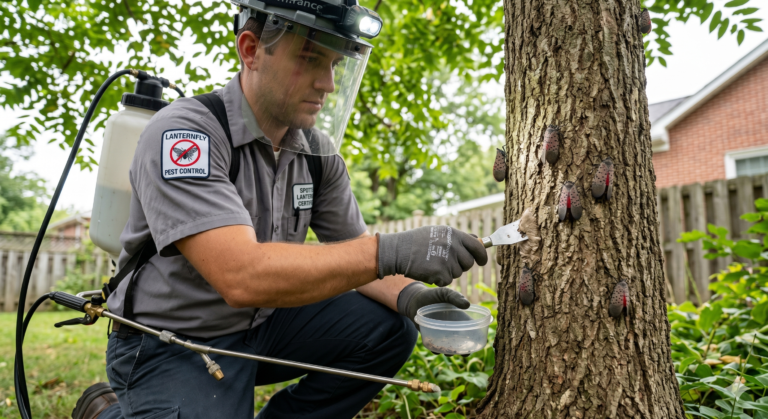
Egg masses are one of the most important early warning signs. Between October and June, spotted lanternflies lay their eggs in grey, putty-like patches about one inch long. These masses appear on tree bark, wooden fences, outdoor furniture, stone walls, and even on vehicles parked outside. Early-stage nymphs emerge in spring, small and black with white spots. As they mature, they develop red patches alongside black and white markings. Adult spotted lanternflies appear from July onward with distinctive grey forewings covered with black spots, and striking red and black patterns on their underwings.
Other signs include sticky, wet patches on tree bark where sap weeps from feeding wounds, black sooty mold forming on surfaces beneath infested trees, and a sweet, fermented smell in your garden. If you notice any of these signs, the infestation has likely grown beyond the early stage and professional treatment is needed without delay.
Why DIY Spotted Lanternfly Control Does Not Work
Many Ashburn homeowners attempt to tackle spotted lanternfly on their own before calling a professional. Scraping egg masses can reduce the number that hatch, but it is nearly impossible to locate and remove every mass across a mature property. A single female can lay multiple egg masses, each containing 30 to 50 eggs, frequently in locations that are difficult to reach or easy to overlook.
Store-bought contact sprays can kill spotted lanternflies on contact, but do nothing to address the root of the infestation. Within days of application, new populations migrate from neighboring properties or hatch from missed egg masses and the problem returns. The most effective treatments are systemic — meaning they are absorbed into the tree and work from the inside out. These professional-grade applications require a licensed
The most effective treatments are systemic and require a professional spotted lanternfly exterminator who understands the lifecycle of the pest and knows exactly when to treat for maximum impact at each stage.
How Bull Run Turf Care & Pest Control Treats Spotted Lanternfly in Ashburn
At Bull Run Turf Care & Pest Control, our approach to spotted lanternfly treatment is thorough, targeted, and timed to the pest’s lifecycle for maximum effectiveness. We begin with a full property inspection, assess the level of infestation, identify host trees, and build a treatment plan specific to your Ashburn property.
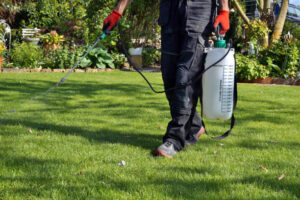
Our treatment methods include trunk injections that deliver systemic insecticide directly into the tree’s vascular system, targeted perimeter sprays applied to affected trees and structures, and direct contact applications during peak adult activity in late summer and fall. For clients who prefer lower-impact options, we offer eco-friendly treatment alternatives. We serve all of Ashburn including zip codes 20147 and 20148.
Our Spotted Lanternfly Treatment Process
- Property inspection and full infestation assessment of all trees and structures
- Identification of host trees and survey of all egg mass locations
- Application of targeted professional-grade systemic and contact treatments
- Follow-up monitoring and seasonal re-treatment to prevent reinfestation
The Cost of Ignoring Spotted Lanternfly on Your Ashburn Property
Every season without professional treatment allows the infestation to grow deeper and spread wider. Mature trees are among the most valuable assets on a residential property — a large, established oak or maple can add thousands of dollars to your home’s value. Repeated spotted lanternfly feeding weakens trees over multiple seasons, making them vulnerable to disease, drought stress, and secondary pest attacks. Severely infested trees may decline to the point where removal is the only option — a cost that far exceeds what professional treatment would have required.
Beyond your own property, untreated infestations spread to neighboring homes and community green spaces. Ashburn’s HOA-maintained common areas are particularly vulnerable once an infestation is established nearby. Early professional treatment is always the most cost-effective choice for your wallet and your landscape.
Serving All of Ashburn and Northern Virginia
Bull Run Turf Care & Pest Control is a locally owned business serving communities throughout Northern Virginia including Ashburn, Chantilly, Fairfax, Herndon, Reston, Leesburg, Sterling, Gainesville, Manassas, and Centreville. When you search for a
When Ashburn residents search for a spotted lanternfly exterminator near me, Bull Run Turf Care & Pest Control delivers professional service backed by local knowledge, licensed technicians, and a genuine commitment to protecting your property year-round.
Frequently Asked Questions
How do I know if I have spotted lanternfly on my Ashburn property?
The most reliable signs are grey, putty-like egg masses on trees and outdoor surfaces between October and June, black and white spotted nymphs on plant stems in spring, and adult grey-winged insects clustering on trees from July through November. You may also notice sticky honeydew residue, black sooty mold, or weeping sap on tree bark. Contact Bull Run Turf Care & Pest Control for a professional property inspection if you spot any of these signs.
When is the best time to treat for spotted lanternfly in Northern Virginia?
Treatment is most effective when timed to the pest’s lifecycle. Winter and early spring are ideal for targeting egg masses before they hatch. April through June targets vulnerable early-stage nymphs. Late summer through fall is critical for targeting the adult population before they lay a new generation of eggs. Year-round monitoring by a professional pest control company gives you the best protection across all lifecycle stages.
Is spotted lanternfly treatment safe for my family and pets?
Yes. Bull Run Turf Care & Pest Control uses professionally applied, targeted treatments selected for effectiveness against spotted lanternfly while minimizing risk to people, pets, and the surrounding environment. Eco-friendly treatment options are also available. After any treatment, our technicians provide clear instructions on any brief precautions — typically staying off treated areas for a short drying period. Your family’s safety is always our top priority.
If spotted lanternfly has found its way onto your Ashburn property, the time to act is now. Every season without professional treatment gives this invasive pest more time to spread, more trees to damage, and more egg masses to hatch next spring. Contact Bull Run Turf Care & Pest Control today to schedule your free spotted lanternfly inspection.
Bull Run Turf Care & Pest Control
4229 Lafayette Center Dr STE 1825, Chantilly, VA 20151, United States