Key Takeaways
- Effective spotted lanternfly control requires understanding the pest’s seasonal lifecycle and applying the right treatment method at the right time.
- DIY spotted lanternfly control methods consistently fall short of professional treatments — especially systemic trunk injections and timed perimeter applications.
- Bull Run Turf Care & Pest Control provides the most comprehensive spotted lanternfly control program available in Chantilly and Northern Virginia.
If you have found yourself searching for spotted lanternfly control near me in Chantilly or anywhere across Northern Virginia, you are not alone. The spotted lanternfly has become one of the most talked-about pest problems in the region, and homeowners are increasingly frustrated by the gap between what they read online about control methods and what actually works on their properties. This article gives you a clear, honest breakdown of spotted lanternfly control options — what is effective, what is not, and why professional treatment delivers results that DIY approaches simply cannot match.
Understanding the Spotted Lanternfly Lifecycle — Why Timing Matters
Spotted lanternfly control is not a single-event solution. This pest has four distinct lifecycle stages throughout the year, and effective control requires addressing each stage with the right approach at the right time.
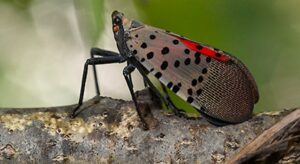
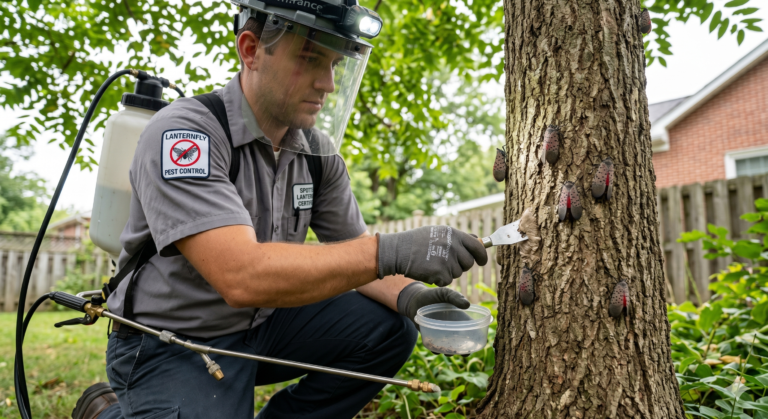
Egg masses overwinter from October through June, laid in grey putty-like patches on trees, fences, vehicles, and outdoor surfaces. Early-stage nymphs emerge from April onward — small, black with white spots — and begin feeding on plant sap immediately. Later-stage nymphs develop red coloring from May through July. Adult insects appear from July through the first hard frost, and it is during the adult stage that spotted lanternflies are most visible and most mobile, swarming on trees and traveling between properties.
A control program that only addresses adults in the fall is missing three-quarters of the year’s population before it reaches reproductive maturity. Comprehensive spotted lanternfly control means taking action at every stage.
What Does Not Work — Common DIY Spotted Lanternfly Control Mistakes
The Virginia Department of Agriculture and Consumer Services has recommended that residents report and attempt to destroy spotted lanternflies when encountered. This has led many homeowners to try a range of DIY approaches, most of which provide limited or temporary results at best.
Scraping egg masses manually is labor-intensive and rarely complete — missing even a few masses means hundreds of new nymphs in spring. Circle traps placed on trees can capture some adult insects but do not reduce populations meaningfully at a property scale. Consumer insecticides available at hardware stores provide contact kill but no residual protection, and populations rebound quickly as new insects migrate from neighboring properties and untreated areas.
None of these approaches deliver the systemic, lifecycle-timed protection that professional spotted lanternfly control provides. The difference is not just in the products used — it is in the knowledge of when to use them and how to apply them effectively across a full property.
What Actually Works — Professional Spotted Lanternfly Control Methods
Professional spotted lanternfly control relies on a combination of approaches that address the pest at multiple lifecycle stages simultaneously:
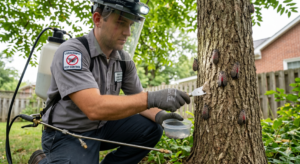
- Systemic trunk injections deliver insecticide directly into the tree’s vascular system, making the tree itself toxic to any spotted lanternfly that feeds on it. This provides season-long protection for treated trees and is the most effective method for preserving high-value trees.
- Basal bark treatments apply systemic insecticide to the base of tree trunks, where it is absorbed into the root system and distributed through the tree — a less invasive alternative to injection that still delivers systemic protection.
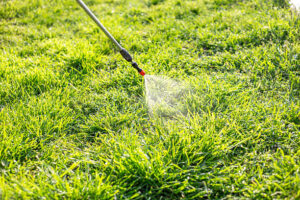
- Contact spray treatments during the nymph and adult stages provide rapid reduction of visible populations and are particularly effective when applied at the right time in the pest’s lifecycle.
- Egg mass removal combined with contact ovicidal treatments in late fall and winter reduces the following spring’s nymph emergence.
The most effective programs combine two or more of these methods, timed to the spotted lanternfly’s seasonal stages, with monitoring between applications to assess activity levels and adjust the program as needed.
Spotted Lanternfly Control in Chantilly — Bull Run’s Approach
Bull Run Turf Care & Pest Control has developed a comprehensive spotted lanternfly control program specifically for Chantilly and Northern Virginia properties. We understand the local landscape, the specific trees most vulnerable in this region, and the seasonal timing of spotted lanternfly activity in Fairfax County.
Our Spotted Lanternfly Control Program
- Full property inspection to identify host trees, egg masses, and active populations
- Customized treatment plan based on infestation severity and tree inventory
- Systemic trunk injections for high-value trees requiring maximum protection
- Timed contact spray applications targeting nymphs in spring and adults in summer and fall
- Egg mass treatment in late fall to reduce spring emergence
- Monitoring visits to assess population levels and adjust treatment timing
Spotted Lanternfly Control Near Me — Why Local Knowledge Matters
When you search for spotted lanternfly control Chantilly, you want a company that understands your specific community — not a national brand applying a generic program. Bull Run Turf Care & Pest Control is based right here in Chantilly, serving homeowners in Fairfax County and throughout Northern Virginia with locally informed, professionally executed spotted lanternfly control. Contact us today for a free inspection and a customized treatment recommendation.
Frequently Asked Questions
What is the most effective method of spotted lanternfly control?
For individual trees, systemic trunk injection is the most effective method available, providing season-long protection by making treated trees toxic to feeding insects. For property-wide control, a combination of systemic treatments, timed contact spray applications, and egg mass management across all lifecycle stages delivers the most comprehensive results. Professional programs that address the pest at every stage of its annual lifecycle consistently outperform single-method DIY approaches.
How many spotted lanternfly treatments do I need per year?
Most properties benefit from two to four professional treatments per year, timed to key points in the spotted lanternfly’s lifecycle: late fall or winter for egg mass management, spring for nymph emergence, and late summer through fall for adult populations. The exact number of treatments depends on infestation severity, the number and type of host trees present, and the level of spotted lanternfly pressure from surrounding properties.
Does spotted lanternfly control also protect against other pests?
Spotted lanternfly treatment programs focus specifically on this pest and the products used are selected for their effectiveness against this species. However, Bull Run Turf Care & Pest Control also offers comprehensive perimeter pest control, mosquito control, and full-service pest management programs that can be combined with spotted lanternfly treatment for complete property protection. Ask about our bundled program options when you contact us.
Effective spotted lanternfly control requires more than a spray and a hope. It requires local knowledge, professional-grade treatments, and a program timed to the pest’s lifecycle. Bull Run Turf Care & Pest Control delivers all three for Chantilly and Northern Virginia homeowners. Call us today to get started.
Bull Run Turf Care & Pest Control
4229 Lafayette Center Dr STE 1825, Chantilly, VA 20151, United States