

Before You Dive In — 3 Key Takeaways:
- Fertilizing at the wrong time or with the wrong product can damage your lawn rather than improve it.
- Leesburg’s clay-dominant soils often require soil testing before any fertilization program to avoid nutrient imbalances.
- A properly timed 5–6 application fertilization program is the foundation of every thick, green Northern Virginia lawn.
Have you ever walked past a neighbor’s lawn in Leesburg and wondered how they manage to keep it so thick and green while yours struggles through the same summer heat and clay soil? The answer almost certainly isn’t a different grass seed or a secret irrigation system. It’s a properly timed, locally informed fertilization program — and the good news is that it’s entirely replicable for any property in Loudoun County.
Effective lawn fertilization leesburg homeowners trust isn’t just about putting product on the ground. It’s about understanding what your specific soil needs, when your grass is ready to absorb nutrients, and how to avoid the common timing mistakes that turn a well-intentioned fertilization application into a waste of money — or worse, a source of damage.
Why Fertilization Is the Foundation of a Great Lawn in Leesburg
Every aspect of your lawn’s appearance and performance — color, density, disease resistance, weed suppression — is influenced by the nutritional status of your turf. Grass is a living plant that requires a consistent supply of nutrients to perform at its best, and in Leesburg’s heavy clay soils, those nutrients don’t always move freely from the soil profile into the root system.
Lawn fertilization works by supplying the three primary macronutrients that turf grass needs most: nitrogen (N), phosphorus (P), and potassium (K). Nitrogen drives the green color and active leaf growth that makes a lawn look healthy and lush. Phosphorus supports root development — critically important for establishing new grass and for helping cool-season turf survive Leesburg’s hot, dry summers. Potassium builds overall plant hardiness, improving resistance to drought, disease, and cold.
A lawn that doesn’t receive adequate fertilization over time will thin, discolor, lose disease resistance, and become increasingly vulnerable to weed pressure. Weeds are opportunists — they colonize the bare and weakened spots that appear when grass plants lack the nutrition to compete.
Understanding NPK Ratios for Leesburg Lawn Types
The NPK numbers on a fertilizer bag represent the percentage of each primary nutrient by weight. For cool-season turf in Leesburg — primarily tall fescue — the general priorities shift by season:
- Spring: Moderate nitrogen for green-up, balanced potassium for stress resistance as summer approaches
- Fall: Higher nitrogen to support active growth and root energy storage, with phosphorus for root development during aeration and overseeding
- Winterizer: High potassium to build cold hardiness; lower nitrogen
Matching the NPK ratio to the season and the grass type is one of the key advantages a professional lawn fertilization provider has over the generic bag-of-fertilizer approach most DIYers default to.
The Right Fertilization Schedule for Leesburg, VA Lawns
For tall fescue lawns in Leesburg, a five-application annual fertilization program represents the gold standard of care. Here’s how that program typically unfolds:
Application 1 — Early Spring (March): A light, slow-release nitrogen application to support green-up without pushing excessive top growth that the root system can’t support. Combined with pre-emergent crabgrass control.
Application 2 — Late Spring (May): A balanced fertilization to sustain growth through the warming weather, often paired with broadleaf weed control for dandelions, clover, and wild violet.
Application 3 — Early Summer (June/July, optional): A minimal, slow-release nitrogen application to sustain color during the heat without triggering disease-promoting growth. Many professionals skip this application for lawns with disease history.
Application 4 — Early Fall (September): The most important application of the year. A high-nitrogen, phosphorus-rich fertilizer supports active fall growth, root energy storage, and recovery from any summer stress. Paired with core aeration and overseeding for best results.
Application 5 — Late Fall/Winterizer (November): A high-potassium formulation applied before the ground freezes to build cold hardiness and support strong spring green-up.
When you search for lawn fertilization near me and find a provider who applies this kind of locally calibrated, seasonally intelligent program, you’ll see the difference in your lawn’s performance within the first season.
Why Fall Is the Most Important Fertilization Window in Northern Virginia
Many Leesburg homeowners invest in spring fertilization and skip the fall — which is exactly backward from what the science of cool-season turf management recommends. Fall is when tall fescue is at its most metabolically active. The combination of warm soil and cool air temperatures creates the ideal growing conditions for root development and carbohydrate storage that will power next spring’s early green-up.
A lawn that receives a quality fall fertilization — ideally paired with aeration and overseeding — enters winter with a dense root system and stored energy. A lawn that skips fall fertilization enters winter thin, stressed, and slow to recover in spring. The fall application is not optional for Leesburg lawns that aim to look their best.
Common Fertilization Mistakes Leesburg Homeowners Make
Even well-intentioned lawn care efforts can go wrong when fertilization timing or product selection is off. Here are the most common and costly mistakes:
Over-fertilizing in summer: Applying high-nitrogen fertilizer during Leesburg’s hot, humid summers promotes the rapid, lush growth that is most susceptible to brown patch disease. It also contributes to thatch buildup and can burn stressed turf. Less is more in summer.
Using the wrong NPK ratio: A fertilizer that’s appropriate for a warm-season bermuda lawn in the South can produce problematic results on a cool-season tall fescue lawn in Leesburg. Always match the product to the grass type and season.
Skipping soil testing: Without knowing your soil’s pH and existing nutrient levels, every fertilizer application is essentially a guess. Leesburg’s clay soils frequently have pH imbalances that block nutrient absorption regardless of how much fertilizer is applied.
Applying before heavy rain or during drought: Rain immediately after application washes granular fertilizer off the lawn before it can be absorbed. Applying fertilizer to drought-stressed turf can cause additional stress rather than relief.
The Role of Soil Testing Before Fertilizing
A soil test is the starting point for any effective Leesburg fertilization program. At a minimum, a soil test will reveal your lawn’s current pH level — the single most important factor in nutrient availability. Most turf grasses in Leesburg thrive in a pH range of 6.0 to 6.8. Soils that are too acidic (below 6.0) or too alkaline (above 7.0) cannot release nutrients effectively, regardless of how much fertilizer you apply.
In Leesburg’s clay soils, pH imbalances are common and are often addressed with lime applications alongside the fertilization program. A proper soil test eliminates the guesswork and ensures that every fertilization dollar you spend is actually working.
Granular vs. Liquid Fertilizers: What Works Best in Leesburg?
Both granular and liquid fertilizers have a place in a Leesburg lawn care program, and understanding the differences helps homeowners evaluate what they’re receiving from their service provider.
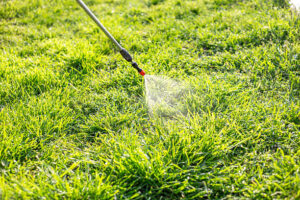
Granular fertilizers are slow-release by design. The nutrient coating dissolves gradually with moisture, delivering a steady supply of nutrition over weeks. They’re well-suited for scheduled applications and easy to apply with a broadcast spreader.
Liquid fertilizers are fast-acting, delivering nutrients directly to the plant within days. They’re particularly useful for addressing visible deficiencies quickly and for applications during periods when soil uptake is limited.
Professional providers often use a combination approach — slow-release granular for scheduled applications and liquid supplementation when faster results are needed. The key is matching the delivery method to the season and the lawn’s current condition.
How Bull Run Turf Care & Pest Control Approaches Fertilization in Leesburg
Bull Run Turf Care & Pest Control builds every Leesburg fertilization program around a soil-first philosophy. Rather than applying the same product at the same rate to every property, Bull Run uses soil assessment data to inform product selection and application rates — ensuring that each treatment delivers maximum value for the specific conditions of your Loudoun County lawn.
Their five-step program is sequenced around Northern Virginia’s actual growing season, not a generic national calendar, which means applications happen at the moments of greatest biological impact for your turf.
Frequently Asked Questions
How long does it take to see results from lawn fertilization?
The timeline depends on the product type. Liquid fertilizer applications typically produce visible color improvement within five to seven days. Granular slow-release products take two to four weeks to show their full effect as the coating gradually dissolves. Density improvement — meaning thicker, more filled-in turf — is a cumulative result that becomes most visible after a full season of properly timed applications.
Can I fertilize my lawn myself or do I need a professional?
DIY fertilization is possible, but the margin for error is significant. Calibrating a spreader incorrectly, applying at the wrong time, or selecting the wrong product for your soil type and grass variety can produce results that range from disappointing to damaging. Professional providers use calibrated equipment, locally sourced soil data, and season-specific product selections to consistently outperform DIY efforts — particularly in Leesburg’s challenging clay soil environment.
Will fertilizing my lawn attract more pests?
A healthy, well-fertilized lawn is actually more resistant to pest pressure than a thin, stressed one. Dense turf provides less hospitable habitat for surface-active pests and supports the robust root system that allows grass to recover quickly from any pest feeding damage. The lawns most vulnerable to pests like grubs, armyworms, and chinch bugs are the thin, nutrient-deficient ones — not the well-fed, healthy ones.
A beautiful Leesburg lawn isn’t an accident — it’s the result of a disciplined, locally informed fertilization program applied at the right times with the right products. Start with a soil test, build a five-step annual program, and let Bull Run Turf Care & Pest Control handle the rest.
Bull Run Turf Care & Pest Control 4229 Lafayette Center Dr STE 1825, Chantilly, VA 20151, United States