

Before You Dive In — 3 Key Takeaways:
- Chantilly lawns often suffer from compacted clay soils and shade from mature trees — both of which require adjusted fertilization strategies.
- Timing is everything: applying fertilizer at the wrong time in Northern Virginia’s climate wastes money and can burn your lawn.
- A 5–6 step professional fertilization program consistently outperforms sporadic DIY applications.
Chantilly is full of beautiful neighborhoods with mature trees, well-kept homes, and — in many cases — lawns that should look better than they do. The same conditions that give Chantilly its character — established tree canopies, older landscaping, the distinctive red clay soils of Fairfax County — also create some of the most challenging lawn care conditions in Northern Virginia. And at the center of almost every lawn performance issue, there’s a fertilization problem.
Whether it’s the wrong product, the wrong timing, or no program at all, fertilization mistakes are the single most common reason Chantilly lawns fail to reach their potential. Lawn fertilization chantilly homeowners can actually rely on isn’t about buying whatever’s on sale at the home improvement store and spreading it in the spring. It’s about understanding what your specific soil and grass type need, and delivering the right nutrition at exactly the right moments in the growing season.
Why Chantilly Lawns Need a Different Fertilization Approach
Chantilly sits squarely in Fairfax County’s Piedmont clay zone, and the soils here behave very differently from the loamy, well-draining soils that most consumer fertilizer programs are designed for. Fairfax County clay is dense, slow to warm in spring, prone to compaction from foot traffic and mowing, and frequently acidic enough to interfere with nutrient availability.
Effective lawn fertilization in Chantilly must account for these soil characteristics at every step. A fertilizer that performs well on sandy or loamy soil may deliver disappointing results on Chantilly clay because the nutrients can’t move freely through the dense soil profile to reach the root zone where the grass plant needs them most. Additionally, many established Chantilly neighborhoods feature significant mature tree canopy — oaks, maples, and tulip poplars — that shade turf, compete for soil moisture and nutrients, and deposit leaf litter that can shift soil pH over time.
How Soil pH Affects Fertilizer Effectiveness in Chantilly
Soil pH is a measure of soil acidity or alkalinity on a scale of 1 to 14, with 7 being neutral. Most cool-season turf grasses in Chantilly perform best in a slightly acidic range of 6.0 to 6.8. When soil pH drops below 6.0 — which is common in Chantilly’s naturally acidic clay soils, particularly under heavy tree canopies — nutrient availability drops sharply. Nitrogen, phosphorus, and potassium become chemically bound to soil particles and are unavailable to grass plants regardless of how much fertilizer is applied.
This is why a soil test and, frequently, a lime application are essential first steps in any Chantilly fertilization program. Correcting soil pH before fertilizing ensures that the nutrients you’re paying for are actually absorbed by your turf.
The Ideal Fertilization Timeline for Chantilly, VA Lawns
For the tall fescue lawns that dominate Chantilly’s residential neighborhoods, a five-step annual program represents the optimal balance of performance and value.
Step 1 — Early Spring (March): A slow-release, balanced fertilizer supporting early green-up, paired with pre-emergent crabgrass control. Avoid high-nitrogen products at this stage — they push top growth faster than the root system can support, leaving the lawn vulnerable to summer stress.
Step 2 — Late Spring (May): A fertilizer and broadleaf weed control application addressing dandelions, wild violet, clover, and other common Chantilly lawn weeds. Broadleaf weed pressure is typically highest in spring before canopy coverage from grass closes in on weed seedlings.
Step 3 — Early Summer (Optional June/July): A light, slow-release nitrogen application to sustain color during the stress period. This step is skipped on lawns with disease history or significant shade, where excessive nitrogen promotes the conditions that lead to brown patch.
Step 4 — Early Fall (September): The most important application of the year. High-nitrogen, phosphorus-supported fertilizer drives active growth and root energy storage during the period when cool-season turf is most metabolically active. Paired with core aeration and overseeding for maximum impact.
Step 5 — Late Fall/Winterizer (November): A high-potassium winterizer application before the ground freezes builds cold hardiness and loads the root system with energy for a strong, early spring green-up.
When you’re searching for lawn fertilization near me and comparing providers, ask specifically about their fall fertilization timing. Providers who apply their “fall” fertilization in August are likely using a national calendar rather than a Fairfax County-specific one — and for cool-season turf in Chantilly, that timing mismatch costs you real results.
Why You Should Never Skip the Late Fall Fertilization in Northern Virginia
The late fall winterizer application is the most skipped and most impactful treatment in the entire Chantilly lawn fertilization calendar. By November, many homeowners have mentally checked out of lawn care for the year — but their turf hasn’t. Tall fescue continues absorbing nutrients and storing root energy through late fall, right up until the ground freezes.
A lawn that receives a winterizer enters winter with dense, well-fed roots and a stored carbohydrate reserve that powers the following spring’s green-up. A lawn that skips winterizer enters winter depleted, wakes up slowly in spring, and spends the early growing season trying to recover rather than growing aggressively. Over multiple seasons, this gap compounds — the winterized lawn pulls steadily ahead of the skipped lawn in density, color, and overall health.
Fertilizer Types: What's Actually in the Bag?
Understanding the fertilizer products being applied to your Chantilly lawn helps you evaluate service quality and ask better questions of your provider.
Slow-release nitrogen products use a polymer or sulfur coating around nitrogen granules to control the rate at which nitrogen becomes available to the plant. This produces a steady, consistent feeding effect over weeks rather than a rapid burst — less burn risk, more sustained color, and fewer applications needed. Most professional fertilization programs rely primarily on slow-release nitrogen.
Quick-release nitrogen acts immediately and produces rapid green-up, but also carries higher burn risk during warm weather and shorter overall efficacy. It’s most useful in early spring for fast green-up or as a component of a balanced blend.
Organic fertilizers — derived from composted plant or animal material — are lower in nutrient concentration but build soil biology over time, improving the overall health of Chantilly’s clay soil. They’re an excellent complement to synthetic fertilization programs rather than a standalone replacement.
Is Organic Fertilizer Worth It for Chantilly Lawns?
Organic fertilizers offer real long-term benefits for Chantilly’s clay soil ecosystem. By introducing beneficial microorganisms and organic matter, they gradually improve soil structure, water retention, and nutrient availability. However, they work slowly — organic nitrogen is released as soil microbes break it down, which can take weeks. For homeowners looking for immediate color improvement or recovery from stress, organic fertilizer alone typically doesn’t deliver fast enough results. Used as a component of an integrated program alongside conventional fertilization, organic products are a worthwhile investment in Chantilly’s challenging soil conditions.
Over-Fertilization: The Lawn Mistake That Costs More Than You Think
More fertilizer is not better, and in Chantilly’s clay soil environment, the consequences of over-fertilization are particularly significant.
Lawn burn occurs when nitrogen concentration in the soil exceeds what grass roots can safely absorb, essentially pulling moisture out of the plant. It appears as yellow or brown streaking that follows the pattern of fertilizer application.
Nitrogen runoff is an environmental concern specific to Northern Virginia — Fairfax County sits in the Chesapeake Bay watershed, and excess nitrogen from lawn fertilization contributes to algae blooms and water quality degradation in local tributaries. Responsible fertilization rates matter both for your lawn and for the broader environment.
Thatch buildup is promoted by excessive nitrogen, which drives rapid top growth faster than the plant’s natural decomposition processes can manage.
Bull Run's Fertilization Programs for Chantilly Homeowners
Bull Run Turf Care & Pest Control approaches Chantilly lawn fertilization with a soil-first philosophy that sets their programs apart from generic service offerings. Every new Chantilly client receives a property assessment that informs product selection, application rates, and a customized seasonal schedule built around Fairfax County’s specific growing conditions.
Their licensed technicians understand the interplay between Chantilly’s clay soil, mature tree canopy, and cool-season turf requirements — and they build programs that work with these conditions rather than against them.
Frequently Asked Questions
How soon after seeding can I fertilize my Chantilly lawn?
Starter fertilizer — a product formulated with higher phosphorus to support root development in new seedlings — can and should be applied at the time of seeding. However, avoid high-nitrogen applications until new grass has germinated and been mowed at least once or twice, typically six to eight weeks after seeding. Applying high-nitrogen fertilizer too early can burn emerging seedlings and produce lush top growth at the expense of the root establishment that new grass needs most.
Should I water after fertilizing?
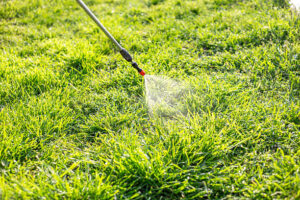
For granular fertilizer applications, watering within 24 hours activates the product by dissolving the granule coating and moving nutrients toward the root zone. Without irrigation or rainfall, granular fertilizer can sit on the surface and volatilize, losing effectiveness. For liquid fertilizer and weed control applications, the opposite applies — you want the product to dry and absorb into the leaf tissue before rain or irrigation, which typically requires 24 to 48 hours of dry conditions after application.
Can fertilization help my lawn recover from drought stress?
Fertilizing a drought-stressed lawn is counterproductive and can cause additional damage. When turf is actively stressed by drought, its roots are compromised and its capacity to absorb nutrients is limited. Applying fertilizer in this condition risks burning the already-stressed grass and forcing growth that the weakened root system cannot support. The correct sequence is to restore soil moisture first — through irrigation or rainfall — allow the lawn to stabilize for one to two weeks, and then resume fertilization with a light, balanced application.
Your Chantilly lawn has everything it needs to look exceptional — the right grass type, the right climate, and the right opportunity for a properly timed fertilization program. All it needs is the right care applied at the right moments. Bull Run Turf Care & Pest Control makes that easy with a locally informed program that delivers consistent results for Fairfax County homeowners season after season.
Bull Run Turf Care & Pest Control 4229 Lafayette Center Dr STE 1825, Chantilly, VA 20151, United States