
Before You Dive In — 3 Key Takeaways:
- Granular compost improves soil structure, water retention, and microbial activity — the three foundations of a healthy Northern Virginia lawn.
- Chantilly’s clay soils benefit enormously from repeated granular compost applications, which break down compaction over time.
- Granular compost is a complement to fertilization, not a replacement — the two work best when applied together as part of an integrated program.
If you’ve been fertilizing your Chantilly lawn on schedule, aerating every fall, and still struggling to get the thick, green results you’re after, the problem may not be above the ground at all. It may be in the soil itself — and granular compost may be exactly what your lawn has been missing.
Most Northern Virginia homeowners know about fertilizer and weed control. Fewer understand the role that soil biology plays in lawn performance, or that you can significantly improve Chantilly’s notoriously difficult clay soil over time with strategic, consistent granular compost applications. Searching for granular compost near me and finding a local provider who understands how to incorporate it into a broader lawn program is a step that separates good Chantilly lawns from truly excellent ones.
What Is Granular Compost and How Is It Different From Mulch or Fertilizer?
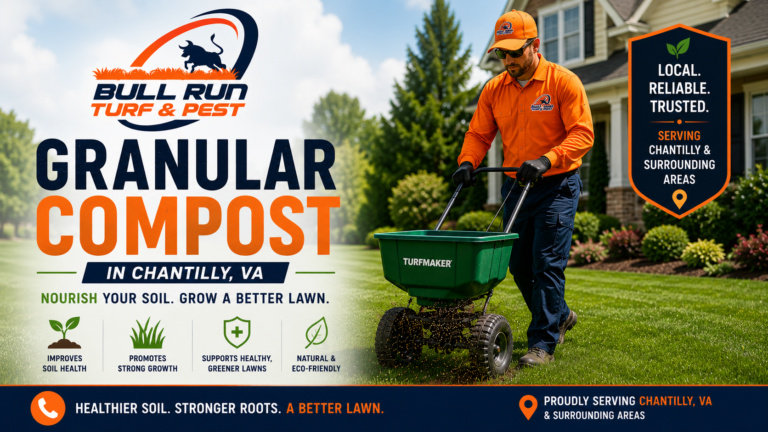
Granular compost is processed, dried organic matter — commonly derived from composted cow manure, biosolids, plant material, or food waste — that has been pelletized into a uniform granular form. Unlike bulk compost, which must be physically spread across the lawn surface in large quantities, granular compost is applied with a standard broadcast spreader at manageable application rates and integrates into the soil profile more quickly and cleanly.
It’s important to understand what granular compost is not. It’s not mulch — mulch is designed to suppress weeds and retain moisture on the soil surface in planting beds, not to feed turf. It’s not a synthetic fertilizer — while granular compost contains nitrogen, phosphorus, and potassium, the concentrations are low and the release rate is slow. Its primary value lies not in its NPK content but in its organic matter content, which physically and biologically transforms the soil over time.
Key Nutrients and Microbes Found in Granular Compost
A typical granular compost product contains a modest NPK ratio — often around 3-2-2 or similar — but the nutrient numbers don’t tell the whole story. The biological payload is equally important. Granular compost introduces:
- Beneficial soil bacteria and fungi that break down organic matter, release bound nutrients, and suppress certain soil-borne pathogens
- Humic acids that improve nutrient uptake efficiency and soil particle aggregation
- Organic matter that physically modifies Chantilly’s clay by creating air pockets, improving water movement, and reducing compaction
Carbon that feeds the entire soil food web and sustains long-term biological activity
Why Chantilly's Clay Soils Need Granular Compost
Chantilly sits atop Fairfax County’s Piedmont clay — a dense, slow-draining soil type that creates persistent challenges for homeowners trying to grow thick, healthy lawns. Clay soils compact easily under foot traffic and equipment, reducing the pore space that grass roots, water, and air need to move freely through the soil profile. Compacted clay repels water instead of absorbing it, drains poorly after heavy rain, bakes hard and cracks in summer drought, and provides poor physical support for root development.
Finding granular compost Chantilly and incorporating it into your annual lawn program is one of the most effective long-term strategies for addressing these clay soil limitations. The organic matter in granular compost acts as a soil amendment — gradually improving the physical structure of clay by promoting the aggregation of clay particles into larger clumps with more space between them. Over successive seasons of application, treated soil develops improved drainage, reduced compaction, and a more hospitable environment for grass root growth.
How Many Applications Are Needed to See Results in Northern Virginia Clay?
Granular compost is a long-term investment in your soil’s health, not a quick fix. Realistic expectations by season:
After the first application: Modest improvement in soil surface texture and water penetration. Visible results in grass color are subtle at this stage.
After one to two full seasons: Measurable improvement in drainage and grass density. The soil begins to develop a more crumbly, workable texture near the surface.
After three or more seasons: Significant structural change in the top several inches of soil. Grass roots penetrate more deeply, water moves more freely, and the lawn demonstrates markedly better drought tolerance and disease resistance than untreated properties.
The homeowners who see the most dramatic results from granular compost are those who commit to annual applications — paired with core aeration — as a consistent part of their lawn care program.
When and How to Apply Granular Compost to Your Lawn
Timing and method both matter for getting the most out of granular compost in Chantilly.
Best timing: Fall is the optimal window for granular compost application in Northern Virginia. Applied immediately following core aeration and before overseeding, granular compost falls into the aeration holes and penetrates the soil profile directly — dramatically improving its effectiveness compared to surface-only application. Spring is a secondary option, particularly for established lawns not being overseeded.
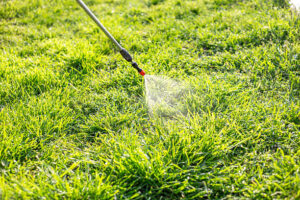
Application method: A standard rotary broadcast spreader delivers granular compost evenly across the lawn surface at the recommended rate — typically 10 to 20 pounds per 1,000 square feet, depending on product concentration and soil conditions. After application, a light irrigation helps the granules begin breaking down and moving into the soil.
What to expect: Granular compost may have a mild organic odor immediately after application that dissipates within one to three days following irrigation. This is normal and is not a sign of product quality issues.
Pairing Granular Compost With Core Aeration for Maximum Impact
The most effective way to apply granular compost to a Chantilly lawn is immediately following core aeration. Here’s why: core aeration removes small plugs of soil from the lawn, creating channels that penetrate several inches into the soil profile. When granular compost is broadcast over the freshly aerated lawn, the product falls into these channels and is delivered directly into the root zone — bypassing the dense clay surface layer that would otherwise slow its integration.
This aeration-plus-compost combination is the single most impactful soil improvement treatment available to Chantilly homeowners, and it’s most effective when scheduled in September to allow grass roots to grow into the improved soil during fall’s active growing period.
Granular Compost vs. Synthetic Fertilizer: Do You Need Both?
Yes — and here’s why. Synthetic fertilizer and granular compost serve fundamentally different purposes, and they work best when used together.
Synthetic fertilizer delivers nutrients directly to grass plants at predictable concentrations and controlled release rates. It’s the fastest and most precise way to address specific nutrient deficiencies and drive visible lawn performance improvements.
Granular compost feeds the soil ecosystem — the billions of bacteria, fungi, and other organisms that create the biological environment in which grass plants thrive. A biologically active soil requires less synthetic fertilizer to produce the same results because it naturally cycles nutrients more efficiently.
Used together, granular compost and synthetic fertilizer create a synergistic effect: the compost builds the soil biology and structure that allows the fertilizer to work more efficiently, while the fertilizer provides the immediate nutritional support that compost alone cannot deliver fast enough.
How Bull Run Turf Care & Pest Control Uses Granular Compost in Chantilly
Bull Run Turf Care & Pest Control incorporates granular compost as a recommended component of their premium lawn programs for Chantilly homeowners with clay soil challenges. Their approach sequences compost application with core aeration and overseeding in fall — the combination that delivers the greatest soil improvement per treatment dollar for Fairfax County clay.
Their technicians assess each property’s soil conditions before recommending application rates, ensuring that granular compost is applied at levels appropriate to the specific needs of your lawn rather than at a one-size-fits-all rate.
Frequently Asked Questions
Will granular compost smell bad on my lawn?
Most granular compost products have a mild organic odor immediately after application — similar to the smell of a garden center or barn. This odor is most pronounced in the first day or two after application and dissipates quickly once the product is watered in and begins to break down. If you’re planning a backyard event, scheduling granular compost application three to five days before the event is a reasonable buffer.
Is granular compost safe for kids and pets?
Plant-based granular composts are generally safe for children and pets after the product has been watered in. Biosolid-based products carry a minor pathogen concern if ingested in large quantities — a good precaution is to keep pets and children off treated areas until after the first irrigation. When in doubt, ask your provider to specify the compost source so you can make an informed decision for your family.
Can I apply granular compost at the same time as fertilizer?
Yes — granular compost and synthetic fertilizer are fully compatible and can be applied during the same service visit using separate spreader passes at their respective application rates. Applying them together as part of an integrated fall treatment — combined with aeration and overseeding — is actually the most efficient and cost-effective approach for Chantilly homeowners looking to maximize the impact of their fall lawn care investment.
If your Chantilly lawn has been underperforming despite fertilization and regular mowing, the problem may be in the soil — and granular compost is one of the most effective, long-term solutions available. Talk to Bull Run Turf Care & Pest Control about adding granular compost to your annual lawn program and start building the soil foundation your turf deserves.
Bull Run Turf Care & Pest Control 4229 Lafayette Center Dr STE 1825, Chantilly, VA 20151, United States