Key Takeaways
Takeaway 1: Fleas and ticks in Leesburg are active for more of the year than most residents assume — ticks remain active in temperatures above 35 degrees Fahrenheit, meaning fall and mild winter days are not safe periods without protection.
Takeaway 2: Treating pets alone does not eliminate flea and tick pressure in the yard — the outdoor population in your lawn, garden beds, and wooded edges is the source that continually reinfests your pets and risks entering the home.
Takeaway 3: Effective flea and tick control requires treating the full life cycle — eggs, larvae, nymphs, and adults — which is why professional yard treatment produces lasting results where consumer products provide only temporary relief.
The common assumption about fleas and ticks is that they’re a warm-weather problem that resolves itself when temperatures drop in fall. This assumption is costing Leesburg families real exposure risk. Ticks — particularly the black-legged tick that transmits Lyme disease — remain active at temperatures as low as 35 degrees Fahrenheit and are known to be active on mild winter days throughout the Loudoun County area. Fleas survive winter in sheltered outdoor locations and in the warmth of homes that have already been infested. The idea of a seasonal break from flea and tick pressure in Leesburg is largely a myth.
What this means practically is that families with children playing in the yard, homeowners with dogs or cats that go outdoors, and anyone spending time in the wooded or grassy areas common to Leesburg’s residential landscape need protection that doesn’t rely on cold weather to do the work. Professional flea and tick control Leesburg homeowners depend on is not a seasonal luxury — it’s a health protection measure that applies to most of the year.
Why Leesburg Is High-Risk Tick Territory
Loudoun County, where Leesburg is located, consistently reports among the higher rates of Lyme disease cases in Virginia. The black-legged tick — also called the deer tick — is the primary vector, and Leesburg’s combination of wooded residential areas, deer populations, and the grassy-to-wooded transition zones that ticks prefer for habitat makes it one of the more tick-dense communities in Northern Virginia.
Ticks don’t jump or fly. They reach hosts by a behavior called questing — climbing to the tips of grass blades, leaf litter, or low vegetation and waiting with their front legs extended to grab onto a passing animal or human. The transition zone between maintained lawn and unmaintained wooded or brushy areas is their prime habitat, and in Leesburg’s established residential neighborhoods, that transition exists on nearly every property in the form of back-fence wooded borders, naturalized areas, or neighboring undeveloped land.
The Flea Problem: From Yard to Pet to Home
Fleas present a different kind of challenge than ticks. While ticks are primarily an outdoor-to-human transmission concern, fleas have a life cycle that allows them to establish inside the home once a pet brings them in — creating an indoor infestation that is far more difficult to resolve than outdoor flea pressure alone.
The flea life cycle is the key to understanding why treatment is complicated. Adults on a pet represent only 5 percent of the total flea population in an infested environment. The other 95 percent — eggs, larvae, and pupae — are in the environment, predominantly in carpet, bedding, furniture, and the outdoor areas where the pet spends time. Treating the pet eliminates the adults currently on the animal but does nothing about the environmental population, which continues to develop and produce new adults that reinfest the pet and the home.
This is why pet owners who treat their animals consistently but not their yard find that flea infestations persist indefinitely. The yard is the source. Flea and tick control near me services that include the outdoor environment — lawn, garden beds, shaded areas, wooded borders — address the source population rather than just managing what reaches the pet.
Why Consumer Products Don’t Solve the Problem
The flea and tick control products available to consumers have limitations that professional treatments don’t share. Most consumer yard sprays are contact-only formulations without meaningful residual activity — they kill what they touch at the time of application and provide little protection against new fleas and ticks that emerge from the life stages the spray didn’t reach or that migrate in from neighboring areas afterward.
For tick control specifically, the size and movement patterns of the target pest create application challenges. Ticks are small, widely distributed across a property, and often concentrated in the exact areas that are hardest to treat effectively with handheld consumer sprayers — deep leaf litter, dense ground cover, wooded edges. Consumer application rarely achieves the coverage depth needed to reach the population in these harborage areas.
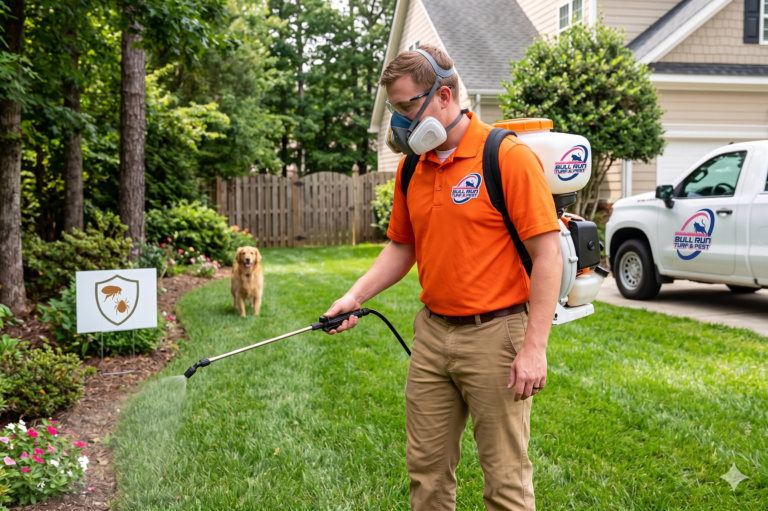
Professional treatments use residual insecticides applied by equipment capable of achieving thorough coverage in harborage areas, combined with growth regulators that interrupt the flea life cycle by preventing larvae from developing into adults. This combination addresses both the current adult population and the developmental pipeline that would otherwise produce ongoing reinfestation.
Protecting Leesburg Families With Professional Treatment
A professional flea and tick control program for a Leesburg property begins with an assessment of the harborage areas that represent the highest population concentration — the shaded, moist, leaf-litter-rich environments along fence lines, under decks, in wooded borders, and in garden beds adjacent to the lawn. These areas receive targeted treatment rather than uniform broadcast application across the entire property, which concentrates the treatment where it produces the most impact.
Treatment schedules are designed to account for the length of the flea development cycle — approximately three to four weeks from egg to adult under warm conditions — with follow-up treatments that catch newly emerging adults before they reproduce. Tick treatment timing accounts for the tick’s seasonal activity peaks in spring and fall, with treatment in the weeks before these peaks providing protection through the highest-risk periods.
Frequently Asked Questions
How soon after professional yard treatment is it safe for my children and pets to go outside?
Re-entry times vary by product but are typically two to four hours for most professional yard treatments once the application has dried. Your technician will provide specific re-entry guidance at the time of service. Keep pets and children inside during application and until the treatment has dried completely.
Should I treat inside the home if my pet has brought fleas inside?
Indoor flea treatment may be necessary if an infestation has established inside the home. Signs of indoor flea infestation include seeing fleas on pets or in carpet, noticing flea bites on humans — particularly around the ankles — or observing flea dirt (black pepper-like specks) in pet bedding. Indoor treatment requires vacuuming to stimulate pupae to emerge, followed by professional treatment that reaches the developmental stages in carpet and furniture.
How often should I schedule professional flea and tick treatment in Leesburg?
Most Leesburg properties benefit from two to three yard treatments per season — one in spring before tick activity peaks, one in early summer to address flea season and tick nymph activity, and one in fall before deer tick populations peak again. Properties in wooded areas or with heavy deer traffic may benefit from additional applications.
Bull Run Turf Care & Pest Control
4229 Lafayette Center Dr STE 1825, Chantilly, VA 20151, United States
Phone: (571) 430-5697
Website: bullrunturf.com
Instagram: @bullruntrf
Facebook: web.facebook.com/bullrunturf