Before You Dive In — 3 Key Takeaways:
- A single pest sighting in a commercial space can result in health code violations, negative reviews, and lost business.
- Commercial pest control requires different strategies than residential — volume, liability, and compliance all play a role.
- Partnering with a local Prince William County pest control provider ensures faster response times and knowledge of regional pest patterns.
It takes years to build a business reputation and only minutes to damage it. A customer photographing a cockroach in a restaurant, a health inspector flagging rodent evidence in a food prep area, or an employee discovering a wasp nest outside the building entrance — these aren’t hypothetical scenarios. They happen to real businesses in Prince William County every season, and the consequences can range from a damaging online review to a full facility shutdown.
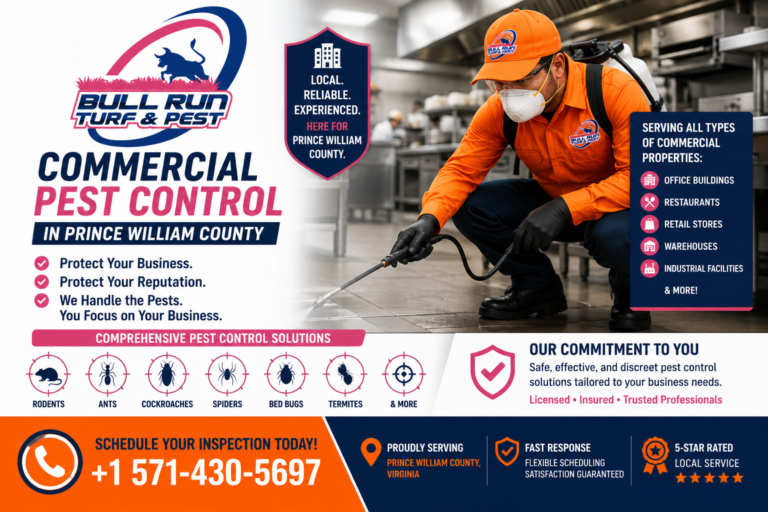
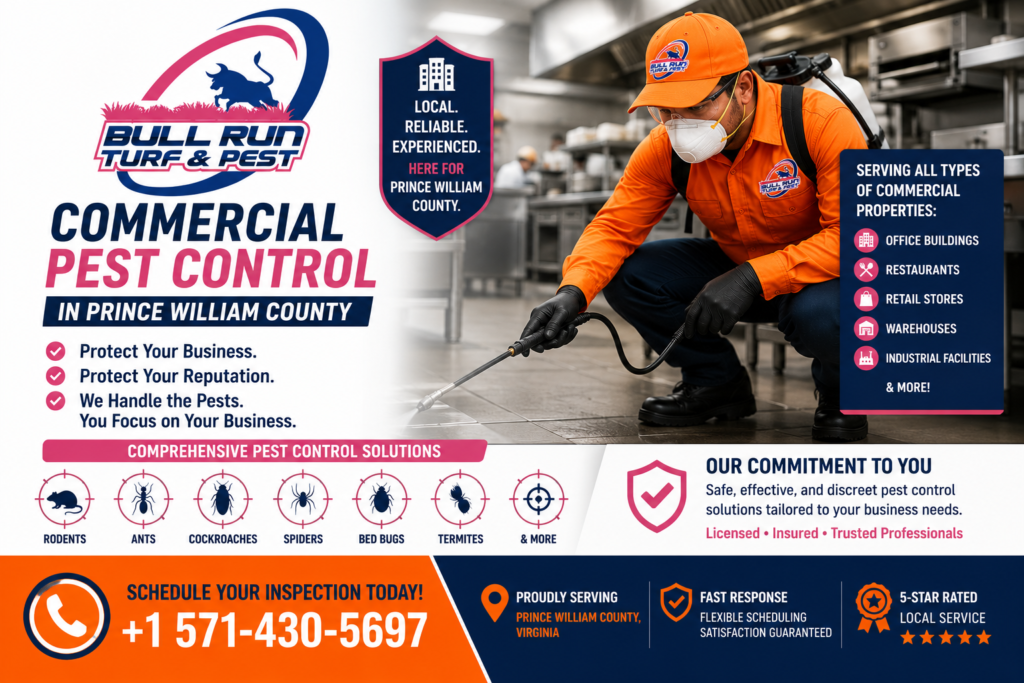
Commercial pest control prince william county businesses need is not a one-size-fits-all service. It requires a customized, compliance-focused approach that addresses the specific pest risks of your industry, facility, and location. This guide will explain what professional commercial pest management really looks like — and why getting it right matters far more than most business owners realize until it’s too late.
Why Commercial Pest Infestations Are More Serious Than Residential Ones
When a pest problem shows up in a home, the consequences are personal and contained. When it shows up in a commercial facility, the consequences are public, legal, and potentially catastrophic. Understanding the difference is the first step toward taking commercial pest management seriously.
Commercial pest control involves a layer of complexity that residential service does not. First, there’s the scale issue — commercial facilities are simply larger, with more entry points, more hiding places, and more food and water sources that attract pests. A pest population that would be considered a moderate infestation in a home can spread to cover an entire restaurant kitchen or warehouse in weeks.
Second, there are regulatory and liability dimensions that don’t exist in residential settings. Businesses in the food service, healthcare, and hospitality industries are subject to health department inspections and must maintain documentation of their pest control activities. A single failed inspection can result in a temporary or permanent closure — and the financial damage from even a brief shutdown often far exceeds the cost of a full year of professional pest management.
Third, there’s the reputational dimension. In the age of online reviews, a single pest sighting reported by a customer on Google or Yelp can shadow a business for years, affecting new customer acquisition long after the pest problem itself has been resolved.
Industries in Prince William County Most at Risk for Pest Infestations
Certain industries face consistently higher pest pressure due to the nature of their operations:
- Restaurants and food service: Constant food availability, moisture, warmth, and high traffic create near-ideal conditions for cockroaches, rodents, and flies.
- Warehouses and distribution centers: Large, difficult-to-seal structures with regular deliveries provide easy entry and harborage for rodents and stored product pests.
- Office buildings: Break rooms, server rooms with warmth, and plumbing chases attract cockroaches and rodents, particularly in older Prince William County building stock.
- Healthcare facilities: Strict sanitation standards mean that any pest activity constitutes a compliance emergency requiring immediate professional response.
Retail centers: High foot traffic brings pests in on packaging and personal belongings; food-adjacent retail is especially vulnerable.
What a Professional Commercial Pest Control Program Includes
A professional commercial pest management program is built around a fundamentally different philosophy than residential service. Rather than simply responding to visible pest activity, it’s designed to prevent infestations before they occur — and to maintain the documentation that regulatory compliance requires.
Commercial pest control near me searches should yield providers who offer the following core program elements:
- Initial facility assessment: A thorough inspection of the entire property, including exterior perimeter, loading docks, mechanical rooms, kitchen/food prep areas, and structural vulnerabilities.
- Integrated Pest Management (IPM) plan: A written strategy that prioritizes the least-disruptive, most targeted interventions before escalating to broader chemical treatments.
- Scheduled treatment visits: Regular service on a frequency appropriate to your facility type and pest risk level, with consistency in technician assignment when possible.
- Service documentation: Written logs of every visit, treatment applied, pest activity observed, and recommendations made — essential for health inspection compliance.
- Emergency response protocol: A defined process for urgent pest situations that arise between scheduled visits.
The Difference Between One-Time Treatments and Ongoing Service Contracts
Business owners sometimes ask whether a one-time treatment can resolve a commercial pest problem. The short answer is almost never. Commercial pest populations are too large, too well-established, and too mobile to be addressed by a single application. More importantly, a one-time treatment provides no ongoing monitoring, no documentation, and no protection against re-infestation — which, in a commercial environment, is virtually guaranteed without continuous preventive management.
Ongoing service contracts, by contrast, provide cumulative protection that improves over time as your provider learns the specific vulnerabilities and pest pressure patterns of your facility. The ROI on a commercial pest contract is straightforward: one avoided health inspection failure or one prevented online pest incident pays for the entire year of service.
Common Pests Targeting Northern Virginia Commercial Properties
Understanding the specific pests most likely to target your Prince William County facility helps set realistic expectations and prioritize treatment strategies.
Rodents are among the most damaging commercial pests, capable of contaminating food supplies, chewing through electrical wiring, and spreading disease. They’re also skilled at exploiting the gaps and utility penetrations common in older commercial buildings.
German cockroaches are the dominant cockroach species in commercial food service environments in Northern Virginia. They reproduce with extraordinary speed — a single female can produce hundreds of offspring over her lifetime — and they’re increasingly resistant to amateur insecticide treatments.
Ants — particularly odorous house ants and pavement ants — are drawn to the food and moisture sources abundant in commercial kitchens and break rooms.
Flies are a persistent problem in food service, particularly during warm months, and can carry dozens of disease-causing pathogens.
Stinging insects — yellowjackets, hornets, and wasps — build nests on building exteriors and present safety and liability risks for employees and customers.
Seasonal Pest Threats for Prince William County Businesses
- Spring: Ant colonies become active and begin foraging; stinging insects begin building nests on exterior walls and eaves.
- Summer: Flies, mosquitoes, and stinging insects reach peak activity. Fruit fly populations explode in food service environments.
- Fall: Rodents and cockroaches begin seeking the warmth of heated commercial spaces as outdoor temperatures drop.
Winter: Rodents are at their most active in commercial buildings during cold months; cockroaches remain active year-round in temperature-controlled facilities.
How Bull Run Turf Care & Pest Control Serves Prince William County Businesses
Bull Run Turf Care & Pest Control brings the same locally informed, detail-oriented approach that Northern Virginia homeowners trust to commercial clients throughout Prince William County. Their commercial services are designed for business owners and property managers who need reliable, documented pest management without the disruption that amateur or one-size-fits-all service creates.
Bull Run’s licensed technicians understand the compliance requirements facing Prince William County businesses, the specific pest pressures of each industry, and the scheduling flexibility that commercial clients require — including early morning, evening, and weekend service windows to avoid disruption to your operations.
Frequently Asked Questions
Do you provide pest control documentation for health inspections?
Yes. Professional commercial pest control providers maintain detailed service logs for every visit, including treatment records, pest activity observations, and corrective action recommendations. This documentation is standard practice in compliant commercial pest management programs and is exactly what Fairfax County and Prince William County health inspectors expect to see during routine facility inspections.
How quickly can you respond to a commercial pest emergency?
Being locally based in the Chantilly area allows Bull Run to respond to commercial pest emergencies in Prince William County far faster than national pest control franchises whose nearest technician may be an hour away. For established commercial clients, same-day or next-day emergency response is a realistic expectation. If a rodent is spotted in a restaurant kitchen or a wasp nest is blocking a customer entrance, a fast response isn’t just convenient — it’s essential for business continuity.
Is commercial pest control more expensive than residential?
Commercial pest control pricing is based on facility size, pest risk level, treatment frequency, and the documentation requirements of the service agreement. While the per-visit cost is generally higher than residential service, the comparison isn’t quite apples to apples. Commercial programs provide documentation, compliance support, emergency response, and a level of liability protection that residential programs simply don’t include. When viewed in the context of the business costs that a pest infestation can generate — fines, lost revenue, reputation damage — the investment in professional commercial pest management delivers significant value.
Don’t wait for a pest problem to affect your Prince William County business’s reputation, compliance standing, or bottom line. Schedule a commercial pest assessment with Bull Run Turf Care & Pest Control today and put a proactive, locally trusted program in place before the next inspection — or the next infestation.
Bull Run Turf Care & Pest Control 4229 Lafayette Center Dr STE 1825, Chantilly, VA 20151, United States